


Verified PEGACPDC25V1 dumps Q&As - 2026 Latest PEGACPDC25V1 Download
Updated 100% Cover Real PEGACPDC25V1 Exam Questions - 100% Pass Guarantee
Pegasystems PEGACPDC25V1 Exam Syllabus Topics:
| Topic | Details |
|---|---|
| Topic 1 |
|
| Topic 2 |
|
| Topic 3 |
|
| Topic 4 |
|
| Topic 5 |
|
| Topic 6 |
|
| Topic 7 |
|
NEW QUESTION # 28
U+ Bank uses a scorecard rule in a decision strategy to compute the mortgage limit for a customer. U+ Bank updated their scorecard to include a new property in the calculation: customer income.
What changes do you need to make in the decision strategy for the updated scorecard to take effect?
- A. A new proposition filter needs to be configured in the strategy to filter on customer income.
- B. Remap the scorecard property in the decision strategy for the change to take effect.
- C. Add a new Group By component for the mortgage limit calculation.
- D. The score calculation is independent of the strategy and no change is required.
Answer: D
Explanation:
The score calculation is independent of the strategy and no change is required. When you use a scorecard component in a decision strategy, you only need to specify the name of the scorecard rule and the output property that will store the score value. The scorecard rule itself defines how the score is calculated based on the input properties and factors. Therefore, if you update the scorecard rule to include a new property in the calculation, you do not need to make any changes in the decision strategy for the updated scorecard to take effect. Verified Reference: [Pega Academy - Decisioning Consultant - Using scorecards]
NEW QUESTION # 29
U+ Bank wants to offer credit cards only to low-risk customers. The customers are divided into various risk segments from Good to Very Poor. The risk segmentation rules that the business provides use the Average Balance and the customer Credit Score.
As a decisioning architect, you decide to use a decision table and a decision strategy to accomplish this requirement in Pega Customer Decision Hub.
Using the decision table, which label is returned for a customer with a credit score of 240 and an average balance 35000?
- A. Fair
- B. Good
- C. Very Poor
- D. Poor
Answer: D
Explanation:
Using the decision table, you can find the label for a customer with a credit score of 240 and an average balance of 35000 by following these steps:
Start from the top row and check if the customer's credit score is less than 150. If yes, then the label is Very Poor. If no, then move to the next row.
Check if the customer's credit score is less than 175 and their average balance is less than 25000. If yes, then the label is Poor. If no, then move to the next row.
Check if the customer's credit score is less than 200 and their average balance is less than 50000. If yes, then the label is Fair. If no, then move to the next row.
Check if the customer's credit score is less than 250 and their average balance is less than 75000. If yes, then the label is Good. If no, then move to the last row.
The last row applies to all other cases that do not match any of the previous conditions. The label for this row is Very Poor.
In this case, the customer's credit score is not less than 150, so the first row does not apply. The customer's credit score is less than 175, but their average balance is not less than 25000, so the second row does not apply either. The customer's credit score is not less than 200, so the third row does not apply. The customer's credit score is less than 250 and their average balance is less than 75000, so the fourth row applies. Therefore, the label for this customer is Poor.
NEW QUESTION # 30
As a decisioning architect, you advise the board on the business issues for which they must use the Next-Best- Action strategy. Which three business issues do you recommend? (Choose Three)
- A. Service
- B. Accounting
- C. Retention
- D. Collections
- E. Resource Planning
Answer: A,C,D
Explanation:
The Next-Best-Action strategy is a customer-centric approach that aims to deliver the most relevant and valuable proposition for each customer at any given moment. You can use the Next-Best-Action strategy to address various business issues that involve customer interactions, such as service, retention, and collections.
Service is the process of providing assistance and support to customers who have questions or problems.
Retention is the process of preventing customers from leaving or switching to competitors. Collections is the process of recovering unpaid debts from customers who are delinquent or defaulting on their obligations.
These are all business issues that can benefit from using the Next-Best-Action strategy. Verified References:
[Pega Decisioning Consultant | Pega Academy]
NEW QUESTION # 31
1yCo, a telecom company, wants to start promoting data plan offers through SMS to qualified customers. The marketing team needs to ensure that the outbound run always uses the latest customer information.
What do you configure to implement this requirement?
- A. Select the Refresh the audience checkbox.
- B. Run the starting population segment daily.
- C. Select a different audience sample with a similar profile.
- D. Trigger an external Extract-Transform-Load (ETL) process.
Answer: A
Explanation:
To implement this requirement, you need to select the Refresh the audience checkbox in the outbound run configuration. This option allows you to refresh the audience data before each run by executing a data flow that reads from your customer data source and updates your customer data set. This way, you can ensure that the outbound run always uses the latest customer information available in your system. Verified References: Pega Academy - Decisioning Consultant - Configuring outbound runs
NEW QUESTION # 32
U+ Bank presents various credit card offers to its customers on its website. The bank uses AI to prioritize the offers according to customer behavior. With the introduction of the Gold credit card offer, the offer click-through propensity decreased to 0.42.
What does the decrease in the propensity value most likely indicate?
- A. Similar customers ignore the offer.
- B. Similar customers do not qualify for the offer.
- C. Similar customers show interest in the offer.
- D. Similar customers purchase other offers.
Answer: A
Explanation:
The propensity is a measure of how likely a customer is to accept an offer, based on their attributes and behaviors. The propensity is calculated by using predictive analytics models that learn from historical data and feedback. A low propensity value indicates that the offer is not relevant or attractive for the customer, and that similar customers have ignored or rejected the offer in the past. Therefore, if the offer click-through propensity decreased to 0.42, it most likely indicates that similar customers ignore the offer. Verified Reference: Pega Decisioning Consultant | Pega Academy
NEW QUESTION # 33
A bank has been running traditional marketing campaigns for many years. One such campaign sends an offer email to qualified customers on day one. On day five, the bank presents a similar offer if the first email is ignored.
If you re-implement this requirement by using the always-on outbound customer engagement paradigm, how do you approach this scenario?
- A. Configure a primary schedule for the original offer email and setup an ad-hoc schedule to send the second email.
- B. Configure the primary schedule to run daily and let the artificial intelligence (AI) choose the best action based on engagement policies.
- C. Create two segments to identify the target audience for each of the two offer emails: day one, and day five. Set up two schedules per day for the two segments.
- D. Create an action with a flow that contains two Send Email shapes, one for each email. Set appropriate wait times between the shapes.
Answer: B
Explanation:
The always-on outbound customer engagement paradigm relies on AI to select the best action for each customer at any given time, based on their profile, context, and behavior. You do not need to create separate segments or schedules for different offers or timings. You can configure the primary schedule to run daily and let the AI choose the best action based on engagement policies, such as contact policies, eligibility rules, suitability rules, and arbitration. The AI will also learn from the customer responses and optimize the action selection over time.
NEW QUESTION # 34
U+ Bank wants to send promotional emails related to credit card offers to their qualified customers. The business intends to use the same action flow template with the desired flow pattern for all the credit card actions.
What do you configure to implement this requirement?
- A. File template
- B. Email treatment
- C. Output template
- D. Dynamic template
Answer: D
NEW QUESTION # 35
What does a dotted line from a "Group By" component to a "Filter" component mean?
- A. To evaluate the "Group By" component, the "Filter" component is evaluated first.
- B. Information from the "Group By" is copied over to the "Filter" component.
- C. There is a one-to-one relationship between the "Group By" and the "Filter" components.
- D. A property from the "Group By" is referenced by the "Filter" component.
Answer: D
NEW QUESTION # 36
An outbound run identifies 150 Standard card offers, 75 on email, and 75 on the SMS channel. If the following volume constraint is applied, how many actions are delivered by the outbound run?
- A. 75 SMSes and 25 emails
- B. 75 emails 25 SMSes
- C. 0
- D. 1
Answer: B
Explanation:
The outbound run delivers 75 emails and 25 SMSes for the Standard card offer because the volume constraint is set to limit the number of actions per channel per day. The email channel has a limit of 75 actions per day, so all 75 email offers are delivered. The SMS channel has a limit of 25 actions per day, so only 25 SMS offers are delivered. The remaining 50 SMS offers are not delivered because they exceed the volume constraint.
NEW QUESTION # 37
In a decision strategy, to use a customer property in an expression, you
- A. define the property as a strategy property
- B. use the property as defined without any prefix
- C. prefix the property with the keyword Customer
- D. define Customer page in Pages & Classes
Answer: D
Explanation:
In a decision strategy, to use a customer property in an expression, you need to define Customer page in Pages
& Classes and specify its class as Data-Customer. This allows you to access customer properties by using dot notation, such as Customer.Age or Customer.Gender. You do not need to define the property as a strategy property, use it without any prefix, or prefix it with the keyword Customer. Verified References: [Certified Pega Decisioning Consultant | Pega Academy], Decision strategies
NEW QUESTION # 38
U+ Bank, a retail bank, uses the business operations environment to perform its business changes. The bank carries out these changes in the Pega Customer Decision Hub portal by using revision management features or the 1:1 Operations Manager portal.
For each task, select the correct portal in which you perform the build tasks based on best practices.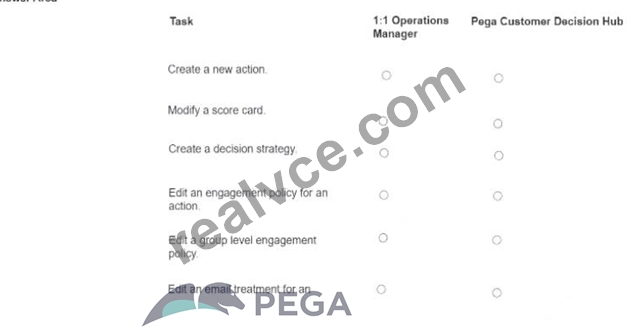
Answer:
Explanation: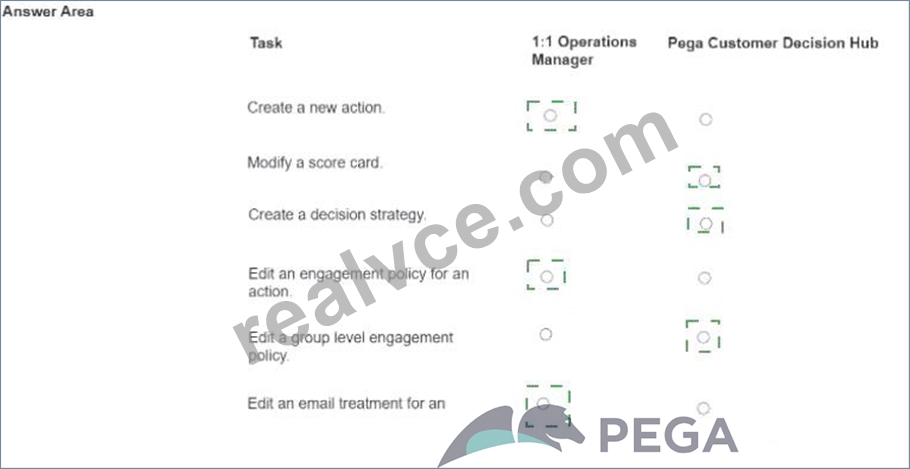
Explanation:
NEW QUESTION # 39
U+ Bank wants to send promotional emails related to credit card offers to their qualified customers. The business intends to use the same action flow template with the desired flow pattern for all the credit card actions.
What do you configure to implement this requirement?
- A. File template
- B. Email treatment
- C. Output template
- D. Dynamic template
Answer: D
Explanation:
To implement this requirement, you need to configure a dynamic template in Customer Decision Hub. A dynamic template is a type of template that allows you to define a common action flow pattern for a group of actions that share similar characteristics, such as channel, issue, or group. You can specify which properties and components are required for each action in the group, and how they are mapped to the action flow template. This way, you can reuse the same action flow template for all the credit card actions, while still allowing some variations in their content and configuration. Verified Reference: Pega Academy - Decisioning Consultant - Creating dynamic templates
NEW QUESTION # 40
U+ Bank implemented a customer journey for its customers. The journey consists of three stages. The first stage raises awareness about available products, the second stage presents available offers, and in the last stage, customers can talk to an advisor to get a personalized quote. The bank wants to actively increase offers promotion over time.
What action does the bank need to take to achieve this business requirement?
- A. Enable constant stage upweighting for the second stage of the journey.
- B. Enable increasing stage upweighting for the first stage of the journey.
- C. Upweight the propensity by adding more predictors that fit the target customers and repeat this process over time.
- D. Enable increasing stage upweighting for the second stage of the journey.
Answer: D
Explanation:
Increasing stage upweighting is a feature that allows you to gradually increase the weight of a stage over time, making the offers in that stage more likely to be selected. This is useful for promoting offers that are time- sensitive or have a limited availability. In this case, the bank wants to actively increase offers promotion over time, so enabling increasing stage upweighting for the second stage of the journey, where the offers are presented, is the best option. Verified References: [Pega Decisioning Consultant | Pega Academy]
NEW QUESTION # 41
U+ Bank, a retail bank, has recently implemented Pega Customer Decision Hub. The bank currently uses an external tool to design email content and a third-party email service provider to send emails to its customers.
As a decisioning architect, how do you recommend the bank implements this requirement?
- A. Create an Internal email treatment and use Customer Decision Hub to design the email.
- B. Create an external email treatment and use Customer Decision Hub to design the email.
- C. Create an external email treatment and use an external tool to design the email.
- D. Create an internal email treatment and import the email content HTML.
Answer: C
NEW QUESTION # 42
U+ Bank, a retail bank, has recently implemented a project in which credit card offers are presented to qualified customers when they log in to the web self-service portal. The bank added engagement policy conditions to show the offers based on the bank's requirements.
In the Answer Area, select the correct engagement policy for each condition.
Answer:
Explanation:
NEW QUESTION # 43
U+- Bank, a retail bank, has recently Implemented a project in which qualified customers see mortgage offers when they log in to the web self-service portal.
Currently, only the customers who satisfy the following engagement policy conditions receive the Fifteen-year fixed-rate mortgage offer:
The bank decides to make two changes:
1. Update the suitability condition for the Fifteen-year fixed-rate mortgage offer.
2. Introduce a new offer, Twenty-year fixed-rate mortgage.
The following table shows the new engagement policy conditions for both mortgage offers:
What is the best practice to fulfill this change management requirement in the business operations environment?
- A. Create a single change request in the 1:1 Operations Manager portal.
- B. Create a single change request in the Pega Customer Decision Hub portal.
- C. Create two change requests: one in the Pega Customer Decision Hub portal and the other in the 1:1 Operations Manager portal.
- D. Create two change requests in the 1:1 Operations Manager portal.
Answer: D
NEW QUESTION # 44
......
Use Real Dumps - 100% Free PEGACPDC25V1 Exam Dumps: https://examcollection.realvce.com/PEGACPDC25V1-original-questions.html