


Jun 05, 2025 Step by Step Guide to Prepare for Databricks-Certified-Professional-Data-Engineer Exam BrainDumps
Databricks Certification Databricks-Certified-Professional-Data-Engineer Real Exam Questions and Answers FREE Updated on 2025
NEW QUESTION # 68
The Databricks CLI is use to trigger a run of an existing job by passing the job_id parameter. The response that the job run request has been submitted successfully includes a filed run_id.
Which statement describes what the number alongside this field represents?
- A. The number of times the job definition has been run in the workspace.
- B. The globally unique ID of the newly triggered run.
- C. The job_id and number of times the job has been are concatenated and returned.
- D. The job_id is returned in this field.
Answer: B
Explanation:
When triggering a job run using the Databricks CLI, the run_id field in the response represents a globally unique identifier for that particular run of the job. This run_id is distinct from the job_id. While the job_id identifies the job definition and is constant across all runs of that job, the run_id is unique to each execution and is used to track and query the status of that specific job run within the Databricks environment. This distinction allows users to manage and reference individual executions of a job directly.
NEW QUESTION # 69
A data engineer has created a transactions Delta table on Databricks that should be used by the analytics team.
The analytics team wants to use the table with another tool that requires Apache Iceberg format.
What should the data engineer do?
- A. Enable uniform on the transactions table to 'iceberg' so that the table can be read as an Iceberg table.
- B. Require the analytics team to use a tool that supports Delta table.
- C. Create an Iceberg copy of the transactions Delta table which can be used by the analytics team.
- D. Convert the transactions Delta table to Iceberg and enable uniform so that the table can be read as a Delta table.
Answer: D
Explanation:
Delta Lake introducedDelta Universal Format (Delta UniForm), which allowsseamless interoperability between Delta Lake and Apache Iceberg. This means a Delta table can beconverted into an Iceberg table while maintaining Delta capabilities.
Explanation of Each Option:
* (A) Require the analytics team to use a tool that supports Delta table
* Incorrect:While Delta Lake is widely used, requiring the team to change toolsis not a flexible or scalable solution.
* (B) Enable uniform on the transactions table to 'iceberg' so that the table can be read as an Iceberg table
* Incorrect:
* The uniform featuremust be enabled after conversion.
* You cannotdirectly enable uniformwithout firstconverting the table.
* (C) Create an Iceberg copy of the transactions Delta table which can be used by the analytics team
* Incorrect:
* Creating a separate Iceberg copy wouldduplicate storage and increase maintenance complexity.
* This is not necessary whenDelta UniForm allows direct compatibility with Iceberg.
* (D) Convert the transactions Delta table to Iceberg and enable uniform so that the table can be read as a Delta table
* Correct:
* The best approach is toconvert the existing Delta table to Icebergusing the Databricks Delta to Iceberg migration tools.
* After conversion,enabling uniform ensures the table remains accessible in both Delta and Iceberg formats.
Conclusion:
The best practice forinteroperability between Delta and Icebergis toconvert the Delta table to Iceberg and enable uniform, ensuringcross-compatibilitywithout data duplication.Thus,Option (D) is the correct answer.
References:
* Delta UniForm for Apache Iceberg - Databricks Documentation
* Convert Delta to Iceberg - Databricks
NEW QUESTION # 70
The data engineer team is configuring environment for development testing, and production before beginning migration on a new data pipeline. The team requires extensive testing on both the code and data resulting from code execution, and the team want to develop and test against similar production data as possible.
A junior data engineer suggests that production data can be mounted to the development testing environments, allowing pre production code to execute against production data. Because all users have Admin privileges in the development environment, the junior data engineer has offered to configure permissions and mount this data for the team.
Which statement captures best practices for this situation?
- A. In environments where interactive code will be executed, production data should only be accessible with read permissions; creating isolated databases for each environment further reduces risks.
- B. Because delta Lake versions all data and supports time travel, it is not possible for user error or malicious actors to permanently delete production data, as such it is generally safe to mount production data anywhere.
- C. All developer, testing and production code and data should exist in a single unified workspace; creating separate environments for testing and development further reduces risks.
- D. Because access to production data will always be verified using passthrough credentials it is safe to mount data to any Databricks development environment.
Answer: A
Explanation:
The best practice in such scenarios is to ensure that production data is handled securely and with proper access controls. By granting only read access to production data in development and testing environments, it mitigates the risk of unintended data modification. Additionally, maintaining isolated databases for different environments helps to avoid accidental impacts on production data and systems.
References:
* Databricks best practices for securing data: https://docs.databricks.com/security/index.html
NEW QUESTION # 71
When defining external tables using formats CSV, JSON, TEXT, BINARY any query on the exter-nal tables caches the data and location for performance reasons, so within a given spark session any new files that may have arrived will not be available after the initial query. How can we address this limitation?
- A. CACHE TABLE table_name
- B. REFRESH TABLE table_name
- C. UNCACHE TABLE table_name
- D. CLEAR CACH table_name
- E. BROADCAST TABLE table_name
Answer: B
Explanation:
Explanation
The answer is REFRESH TABLE table_name
REFRESH TABLE table_name will force Spark to refresh the availability of external files and any changes.
When spark queries an external table it caches the files associated with it, so that way if the table is queried again it can use the cached files so it does not have to retrieve them again from cloud object storage, but the drawback here is that if new files are available Spark does not know until the Refresh command is ran.
NEW QUESTION # 72
Which of the following features of data lakehouse can help you meet the needs of both workloads?
- A. Data lakehouse fully exists in the cloud.
- B. Data lakehouse provides autoscaling for compute clusters.
- C. Data lakehouse requires very little data modeling.
- D. Data lakehouse combines compute and storage for simple governance.
- E. Data lakehouse can store unstructured data and support ACID transactions.
Answer: E
Explanation:
Explanation
The answer is A data lakehouse stores unstructured data and is ACID-compliant,
NEW QUESTION # 73
At the end of the inventory process a file gets uploaded to the cloud object storage, you are asked to build a process to ingest data which of the following method can be used to ingest the data incrementally, the schema of the file is expected to change overtime ingestion process should be able to handle these changes automatically. Below is the auto loader command to load the data, fill in the blanks for successful execution of the below code.
1.spark.readStream
2..format("cloudfiles")
3..option("cloudfiles.format","csv)
4..option("_______", 'dbfs:/location/checkpoint/')
5..load(data_source)
6..writeStream
7..option("_______",' dbfs:/location/checkpoint/')
8..option("mergeSchema", "true")
9..table(table_name))
- A. checkpointlocation, schemalocation
- B. checkpointlocation, cloudfiles.schemalocation
- C. schemalocation, checkpointlocation
- D. cloudfiles.schemalocation, checkpointlocation
- E. cloudfiles.schemalocation, cloudfiles.checkpointlocation
Answer: D
Explanation:
Explanation
The answer is cloudfiles.schemalocation, checkpointlocation
When reading the data cloudfiles.schemalocation is used to store the inferred schema of the incoming data.
When writing a stream to recover from failures checkpointlocation is used to store the offset of the byte that was most recently processed.
NEW QUESTION # 74
Which statement describes Delta Lake optimized writes?
- A. Optimized writes logical partitions instead of directory partitions partition boundaries are only represented in metadata fewer small files are written.
- B. An asynchronous job runs after the write completes to detect if files could be further compacted; yes, an OPTIMIZE job is executed toward a default of 1 GB.
- C. Before a job cluster terminates, OPTIMIZE is executed on all tables modified during the most recent job.
- D. A shuffle occurs prior to writing to try to group data together resulting in fewer files instead of each executor writing multiple files based on directory partitions.
Answer: D
Explanation:
Delta Lake optimized writes involve a shuffle operation before writing out data to the Delta table. The shuffle operation groups data by partition keys, which can lead to a reduction in the number of output files and potentially larger files, instead of multiple smaller files. This approach can significantly reduce the total number of files in the table, improve read performance by reducing the metadata overhead, and optimize the table storage layout, especially for workloads with many small files.
Reference:
Databricks documentation on Delta Lake performance tuning: https://docs.databricks.com/delta/optimizations/auto-optimize.html
NEW QUESTION # 75
A data engineer has developed a code block to perform a streaming read on a data source. The code block is
below:
1. (spark
2. .read
3. .schema(schema)
4. .format("cloudFiles")
5. .option("cloudFiles.format", "json")
6. .load(dataSource)
7. )
The code block is returning an error.
Which of the following changes should be made to the code block to configure the block to successfully
perform a streaming read?
- A. The .read line should be replaced with .readStream
- B. The .format("cloudFiles") line should be replaced with .format("stream")
- C. A new .stream line should be added after the .read line
- D. A new .stream line should be added after the spark line
- E. A new .stream line should be added after the .load(dataSource) line
Answer: A
NEW QUESTION # 76
Which statement regarding stream-static joins and static Delta tables is correct?
- A. Each microbatch of a stream-static join will use the most recent version of the static Delta table as of the job's initialization.
- B. Each microbatch of a stream-static join will use the most recent version of the static Delta table as of each microbatch.
- C. The checkpoint directory will be used to track updates to the static Delta table.
- D. The checkpoint directory will be used to track state information for the unique keys present in the join.
- E. Stream-static joins cannot use static Delta tables because of consistency issues.
Answer: B
Explanation:
This is the correct answer because stream-static joins are supported by Structured Streaming when one of the tables is a static Delta table. A static Delta table is a Delta table that is not updated by any concurrent writes, such as appends or merges, during the execution of a streaming query. In this case, each microbatch of a stream-static join will use the most recent version of the static Delta table as of each microbatch, which means it will reflect any changes made to the static Delta table before the start of each microbatch. Verified Reference: [Databricks Certified Data Engineer Professional], under "Structured Streaming" section; Databricks Documentation, under "Stream and static joins" section.
NEW QUESTION # 77
A junior data engineer is working to implement logic for a Lakehouse table named silver_device_recordings. The source data contains 100 unique fields in a highly nested JSON structure.
The silver_device_recordings table will be used downstream to power several production monitoring dashboards and a production model. At present, 45 of the 100 fields are being used in at least one of these applications.
The data engineer is trying to determine the best approach for dealing with schema declaration given the highly-nested structure of the data and the numerous fields.
Which of the following accurately presents information about Delta Lake and Databricks that may impact their decision-making process?
- A. Because Delta Lake uses Parquet for data storage, data types can be easily evolved by just modifying file footer information in place.
- B. The Tungsten encoding used by Databricks is optimized for storing string data; newly-added native support for querying JSON strings means that string types are always most efficient.
- C. Schema inference and evolution on .Databricks ensure that inferred types will always accurately match the data types used by downstream systems.
- D. Because Databricks will infer schema using types that allow all observed data to be processed, setting types manually provides greater assurance of data quality enforcement.
- E. Human labor in writing code is the largest cost associated with data engineering workloads; as such, automating table declaration logic should be a priority in all migration workloads.
Answer: D
Explanation:
This is the correct answer because it accurately presents information about Delta Lake and Databricks that may impact the decision-making process of a junior data engineer who is trying to determine the best approach for dealing with schema declaration given the highly-nested structure of the data and the numerous fields. Delta Lake and Databricks support schema inference and evolution, which means that they can automatically infer the schema of a table from the source data and allow adding new columns or changing column types without affecting existing queries or pipelines. However, schema inference and evolution may not always be desirable or reliable, especially when dealing with complex or nested data structures or when enforcing data quality and consistency across different systems. Therefore, setting types manually can provide greater assurance of data quality enforcement and avoid potential errors or conflicts due to incompatible or unexpected data types. Verified Reference: [Databricks Certified Data Engineer Professional], under "Delta Lake" section; Databricks Documentation, under "Schema inference and partition of streaming DataFrames/Datasets" section.
NEW QUESTION # 78
The security team is exploring whether or not the Databricks secrets module can be leveraged for connecting to an external database.
After testing the code with all Python variables being defined with strings, they upload the password to the secrets module and configure the correct permissions for the currently active user. They then modify their code to the following (leaving all other variables unchanged).
Which statement describes what will happen when the above code is executed?
- A. The connection to the external table will succeed; the string value of password will be printed in plain text.
- B. An interactive input box will appear in the notebook; if the right password is provided, the connection will succeed and the encoded password will be saved to DBFS.
- C. The connection to the external table will fail; the string "redacted" will be printed.
- D. An interactive input box will appear in the notebook; if the right password is provided, the connection will succeed and the password will be printed in plain text.
- E. The connection to the external table will succeed; the string "redacted" will be printed.
Answer: E
Explanation:
This is the correct answer because the code is using the dbutils.secrets.get method to retrieve the password from the secrets module and store it in a variable. The secrets module allows users to securely store and access sensitive information such as passwords, tokens, or API keys. The connection to the external table will succeed because the password variable will contain the actual password value. However, when printing the password variable, the string "redacted" will be displayed instead of the plain text password, as a security measure to prevent exposing sensitive information in notebooks. Verified Reference: [Databricks Certified Data Engineer Professional], under "Security & Governance" section; Databricks Documentation, under "Secrets" section.
NEW QUESTION # 79
The data governance team has instituted a requirement that all tables containing Personal Identifiable Information (PH) must be clearly annotated. This includes adding column comments, table comments, and setting the custom table property "contains_pii" = true.
The following SQL DDL statement is executed to create a new table:
Which command allows manual confirmation that these three requirements have been met?
- A. DESCRIBE HISTORY dev.pii test
- B. SHOW TABLES dev
- C. DESCRIBE DETAIL dev.pii test
- D. DESCRIBE EXTENDED dev.pii test
- E. SHOW TBLPROPERTIES dev.pii test
Answer: D
Explanation:
This is the correct answer because it allows manual confirmation that these three requirements have been met.
The requirements are that all tables containing Personal Identifiable Information (PII) must be clearly annotated, which includes adding column comments, table comments, and setting the custom table property
"contains_pii" = true. The DESCRIBE EXTENDED command is used to display detailed information about a table, such as its schema, location, properties, and comments. By using this command on the dev.pii_test table, one can verify that the table has been created with the correct column comments, table comment, and custom table property as specified in the SQL DDL statement. Verified References: [Databricks Certified Data Engineer Professional], under "Lakehouse" section; Databricks Documentation, under "DESCRIBE EXTENDED" section.
NEW QUESTION # 80
Which of the statements are correct about lakehouse?
- A. Lakehouse supports schema enforcement and evolution
- B. In Lakehouse Storage and compute are coupled
- C. Lakehouse only supports end-to-end streaming workloads and Data warehouses support Batch workloads
- D. Lakehouse does not support ACID
- E. Lakehouse only supports Machine learning workloads and Data warehouses support BI workloads
Answer: A
Explanation:
Explanation
The answer is Lakehouse supports schema enforcement and evolution,
Lakehouse using Delta lake can not only enforce a schema on write which is contrary to traditional big data systems that can only enforce a schema on read, it also supports evolving schema over time with the ability to control the evolution.
For example below is the Dataframe writer API and it supports three modes of enforcement and evolution, Default: Only enforcement, no changes are allowed and any schema drift/evolution will result in failure.
Merge: Flexible, supports enforcement and evolution
* New columns are added
* Evolves nested columns
* Supports evolving data types, like Byte to Short to Integer to Bigint How to enable:
* DF.write.format("delta").option("mergeSchema", "true").saveAsTable("table_name")
* or
* spark.databricks.delta.schema.autoMerge = True ## Spark session
Overwrite: No enforcement
* Dropping columns
* Change string to integer
* Rename columns
How to enable:
* DF.write.format("delta").option("overwriteSchema", "True").saveAsTable("table_name") What Is a Lakehouse? - The Databricks Blog Graphical user interface, text, application Description automatically generated
NEW QUESTION # 81
A junior data engineer has manually configured a series of jobs using the Databricks Jobs UI. Upon reviewing their work, the engineer realizes that they are listed as the "Owner" for each job. They attempt to transfer "Owner" privileges to the "DevOps" group, but cannot successfully accomplish this task.
Which statement explains what is preventing this privilege transfer?
- A. Other than the default "admins" group, only individual users can be granted privileges on jobs.
- B. The creator of a Databricks job will always have "Owner" privileges; this configuration cannot be changed.
- C. A user can only transfer job ownership to a group if they are also a member of that group.
- D. Only workspace administrators can grant "Owner" privileges to a group.
- E. Databricks jobs must have exactly one owner; "Owner" privileges cannot be assigned to a group.
Answer: E
Explanation:
The reason why the junior data engineer cannot transfer "Owner" privileges to the "DevOps" group is that Databricks jobs must have exactly one owner, and the owner must be an individual user, not a group. A job cannot have more than one owner, and a job cannot have a group as an owner. The owner of a job is the user who created the job, or the user who was assigned the ownership by another user. The owner of a job has the highest level of permission on the job, and can grant or revoke permissions to other users or groups. However, the owner cannot transfer the ownership to a group, only to another user. Therefore, the junior data engineer's attempt to transfer "Owner" privileges to the "DevOps" group is not possible. Reference:
Jobs access control: https://docs.databricks.com/security/access-control/table-acls/index.html Job permissions: https://docs.databricks.com/security/access-control/table-acls/privileges.html#job-permissions
NEW QUESTION # 82
Which statement describes integration testing?
- A. Validates behavior of individual elements of your application
- B. Validates interactions between subsystems of your application
- C. Validates an application use case
- D. Requires manual intervention
- E. Requires an automated testing framework
Answer: B
Explanation:
Explanation
This is the correct answer because it describes integration testing. Integration testing is a type of testing that validates interactions between subsystems of your application, such as modules, components, or services.
Integration testing ensures that the subsystems work together as expected and produce the correct outputs or results. Integration testing can be done at different levels of granularity, such as component integration testing, system integration testing, or end-to-end testing. Integration testing can help detect errors or bugs that may not be found by unit testing, which only validates behavior of individual elements of your application. Verified References: [Databricks Certified Data Engineer Professional], under "Testing" section; Databricks Documentation, under "Integration testing" section.
NEW QUESTION # 83
Which of the following array functions takes input column return unique list of values in an array?
- A. ARRAY_INTERSECT
- B. COLLECT_LIST
- C. ARRAY_UNION
- D. COLLECT_SET
- E. COLLECT_UNION
Answer: D
Explanation:
Explanation
Table Description automatically generated
NEW QUESTION # 84
A user new to Databricks is trying to troubleshoot long execution times for some pipeline logic they are working on. Presently, the user is executing code cell-by-cell, usingdisplay()calls to confirm code is producing the logically correct results as new transformations are added to an operation. To get a measure of average time to execute, the user is running each cell multiple times interactively.
Which of the following adjustments will get a more accurate measure of how code is likely to perform in production?
- A. The only way to meaningfully troubleshoot code execution times in development notebooks Is to use production-sized data and production-sized clusters with Run All execution.
- B. The Jobs Ul should be leveraged to occasionally run the notebook as a job and track execution time during incremental code development because Photon can only be enabled on clusters launched for scheduled jobs.
- C. Scala is the only language that can be accurately tested using interactive notebooks; because the best performance is achieved by using Scala code compiled to JARs. all PySpark and Spark SQL logic should be refactored.
- D. Calling display () forces a job to trigger, while many transformations will only add to the logical query plan; because of caching, repeated execution of the same logic does not provide meaningful results.
- E. Production code development should only be done using an IDE; executing code against a local build of open source Spark and Delta Lake will provide the most accurate benchmarks for how code will perform in production.
Answer: D
Explanation:
This is the correct answer because it explains which of the following adjustments will get a more accurate measure of how code is likely to perform in production. The adjustment is that calling display() forces a job to trigger, while many transformations will only add to the logical query plan; because of caching, repeated execution of the same logic does not provide meaningful results. When developing code in Databricks notebooks, one should be aware of how Spark handles transformations and actions. Transformations are operations that create a new DataFrame or Dataset from an existing one, such as filter, select, or join. Actions are operations that trigger a computation on a DataFrame or Dataset and return a result to the driver program or write it to storage, such as count, show, or save. Calling display() on a DataFrame or Dataset is also an action that triggers a computation and displays the result in a notebook cell. Spark uses lazy evaluation for transformations, which means that they are not executed until an action is called. Spark also uses caching to store intermediate results in memory or disk for faster access in subsequent actions. Therefore, calling display() forces a job to trigger, while many transformations will only add to the logical query plan; because of caching, repeated execution of the same logic does not provide meaningful results. To get a more accurate measure of how code is likely to perform in production, one should avoid calling display() too often or clear the cache before running each cell. Verified References: [Databricks Certified Data Engineer Professional], under "Spark Core" section; Databricks Documentation, under "Lazy evaluation" section; Databricks Documentation, under "Caching" section.
NEW QUESTION # 85
A data team's Structured Streaming job is configured to calculate running aggregates for item sales to update a downstream marketing dashboard. The marketing team has introduced a new field to track the number of times this promotion code is used for each item. A junior data engineer suggests updating the existing query as follows: Note that proposed changes are in bold.
Which step must also be completed to put the proposed query into production?
- A. Remove .option (mergeSchema', true') from the streaming write
- B. Run REFRESH TABLE delta, /item_agg'
- C. Specify a new checkpointlocation
- D. Increase the shuffle partitions to account for additional aggregates
Answer: C
Explanation:
When introducing a new aggregation or a change in the logic of a Structured Streaming query, it is generally necessary to specify a new checkpoint location. This is because the checkpoint directory contains metadata about the offsets and the state of the aggregations of a streaming query. If the logic of the query changes, such as including a new aggregation field, the state information saved in the current checkpoint would not be compatible with the new logic, potentially leading to incorrect results or failures. Therefore, to accommodate the new field and ensure the streaming job has the correct starting point and state information for aggregations, a new checkpoint location should be specified.
References:
* Databricks documentation on Structured Streaming: https://docs.databricks.com/spark/latest/structured- streaming/index.html
* Databricks documentation on streaming checkpoints: https://docs.databricks.com/spark/latest/structured- streaming/production.html#checkpointing
NEW QUESTION # 86
The data science team has created and logged a production model using MLflow. The following code correctly imports and applies the production model to output the predictions as a new DataFrame namedpredswith the schema "customer_id LONG, predictions DOUBLE, date DATE".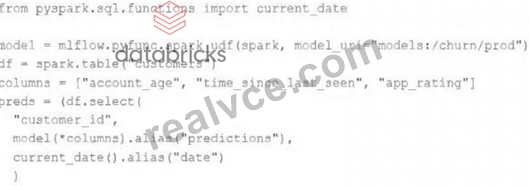
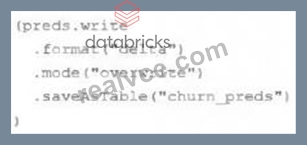
The data science team would like predictions saved to a Delta Lake table with the ability to compare all predictions across time. Churn predictions will be made at most once per day.
Which code block accomplishes this task while minimizing potential compute costs?
- A.
- B.

- C. preds.write.mode("append").saveAsTable("churn_preds")
- D. preds.write.format("delta").save("/preds/churn_preds")
- E.

Answer: C
NEW QUESTION # 87
A junior data engineer is migrating a workload from a relational database system to the Databricks Lakehouse. The source system uses a star schema, leveraging foreign key constrains and multi-table inserts to validate records on write.
Which consideration will impact the decisions made by the engineer while migrating this workload?
- A. Databricks only allows foreign key constraints on hashed identifiers, which avoid collisions in highly-parallel writes.
- B. Foreign keys must reference a primary key field; multi-table inserts must leverage Delta Lake's upsert functionality.
- C. All Delta Lake transactions are ACID compliance against a single table, and Databricks does not enforce foreign key constraints.
- D. Committing to multiple tables simultaneously requires taking out multiple table locks and can lead to a state of deadlock.
Answer: C
Explanation:
In Databricks and Delta Lake, transactions are indeed ACID-compliant, but this compliance is limited to single table transactions. Delta Lake does not inherently enforce foreign key constraints, which are a staple in relational database systems for maintaining referential integrity between tables. This means that when migrating workloads from a relational database system to Databricks Lakehouse, engineers need to reconsider how to maintain data integrity and relationships that were previously enforced by foreign key constraints. Unlike traditional relational databases where foreign key constraints help in maintaining the consistency across tables, in Databricks Lakehouse, the data engineer has to manage data consistency and integrity at the application level or through careful design of ETL processes.
Reference:
Databricks Documentation on Delta Lake: Delta Lake Guide
Databricks Documentation on ACID Transactions in Delta Lake: ACID Transactions in Delta Lake
NEW QUESTION # 88
Define an external SQL table by connecting to a local instance of an SQLite database using JDBC
- A. 1.CREATE TABLE users_jdbc
2.USING org.apache.spark.sql.jdbc
3.OPTIONS (
4. url = "jdbc:sqlite:/sqmple_db",
5. dbtable = "users"
6.) - B. 1.CREATE TABLE users_jdbc
2.USING org.apache.spark.sql.jdbc.sqlite
3.OPTIONS (
4. url = "jdbc:/sqmple_db",
5. dbtable = "users"
6.) - C. 1.CREATE TABLE users_jdbc
2.USING SQL
3.URL = {server:"jdbc:/sqmple_db",dbtable: "users"} - D. 1.CREATE TABLE users_jdbc
2.USING SQL
3.OPTIONS (
4. url = "jdbc:sqlite:/sqmple_db",
5. dbtable = "users"
6.) - E. 1.CREATE TABLE users_jdbc
2.USING SQLITE
3.OPTIONS (
4. url = "jdbc:/sqmple_db",
5. dbtable = "users"
6.)
Answer: B
Explanation:
Explanation
The answer is,
1.CREATE TABLE users_jdbc
2.USING org.apache.spark.sql.jdbc
3.OPTIONS (
4. url = "jdbc:sqlite:/sqmple_db",
5. dbtable = "users"
6.)
Databricks runtime currently supports connecting to a few flavors of SQL Database including SQL Server, My SQL, SQL Lite and Snowflake using JDBC.
1.CREATE TABLE <jdbcTable>
2.USING org.apache.spark.sql.jdbc or JDBC
3.OPTIONS (
4. url = "jdbc:<databaseServerType>://<jdbcHostname>:<jdbcPort>",
5. dbtable " = <jdbcDatabase>.atable",
6. user = "<jdbcUsername>",
7. password = "<jdbcPassword>"
8.)
For more detailed documentation
SQL databases using JDBC - Azure Databricks | Microsoft Docs
NEW QUESTION # 89
Kevin is the owner of both the sales table and regional_sales_vw view which uses the sales table as the underlying source for the data, and Kevin is looking to grant select privilege on the view regional_sales_vw to one of newly joined team members Steven. Which of the following is a true statement?
- A. Steve will also require SELECT access on the underlying table
- B. Kevin can not grant access to Steven since he does not have security admin privilege
- C. Kevin can grant access to the view, because he is the owner of the view and the under-lying table
- D. Kevin can not grant access to Steven since he does have workspace admin privilege
- E. Kevin although is the owner but does not have ALL PRIVILEGES permission
Answer: C
Explanation:
Explanation
The answer is, Kevin can grant access to the view, because he is the owner of the view and the un-derlying table, Ownership determines whether or not you can grant privileges on derived objects to other users, a user who creates a schema, table, view, or function becomes its owner. The owner is granted all privileges and can grant privileges to other users
NEW QUESTION # 90
A data engineer is testing a collection of mathematical functions, one of which calculates the area under a curve as described by another function.
Which kind of the test does the above line exemplify?
- A. Integration
- B. Manual
- C. functional
- D. Unit
Answer: D
Explanation:
A unit test is designed to verify the correctness of a small, isolated piece of code, typically a single function. Testing a mathematical function that calculates the area under a curve is an example of a unit test because it is testing a specific, individual function to ensure it operates as expected.
Reference:
Software Testing Fundamentals: Unit Testing
NEW QUESTION # 91
Which of the following type of tasks cannot setup through a job?
- A. Notebook
- B. Databricks SQL Dashboard refresh
- C. DELTA LIVE PIPELINE
- D. Python
- E. Spark Submit
Answer: B
NEW QUESTION # 92
......
Ultimate Guide to Prepare Databricks-Certified-Professional-Data-Engineer Certification Exam for Databricks Certification: https://examcollection.realvce.com/Databricks-Certified-Professional-Data-Engineer-original-questions.html