


[UPDATED 2025] Oracle 1z0-1067-24 Questions Prepare with Free Demo of PDF
NEW 2025 Certification Sample Questions 1z0-1067-24 Dumps & Practice Exam
NEW QUESTION # 48
To upload a file from a compute instance into Object Storage, you SSH into the compute instance and run the following OCI CLI command: oci os object put -ns mynamespace -bn mybucket --name myfile.txt --file /Users/me/myfile.txt --auth instance_principal Which statement must be true for this command to succeed?
- A. Your OCI API key has been placed on the compute instance.
- B. The bucket has a pre-authenticated request (PAR) that specifies the compute instance that will upload to it.
- C. The instance matches a matching rule for a dynamic group with the permission to up-load to the bucket.
- D. Your OCI user has the permission to upload to the bucket.
Answer: C
NEW QUESTION # 49
You run a large global application with 90% of customers based in the US and Canad a. You want to be able to test a new feature and allow a small percentage of users to access the new version of your application. What Oracle Cloud Infrastructure Traffic Management steering policy should you utilize? (Choose the best answer.)
- A. Geolocation steering
- B. ASN steering
- C. IP Prefix steering
- D. Load Balancer
Answer: D
NEW QUESTION # 50
Several development teams in your company have each been provided with a budget and a dedicated compartment to be used for testing purpose u are asked to help them to control the costs and avoid any overspending. What should you do?
- A. Associate a Budget Tag to each compartment with the monthly budget amount and set an alert rule to notify the developers' teams when they reached a specific percentage of the budget.
- B. Configure a Quota for each compartment to prevent provisioning of any bare metal in-stances.
- C. Contact Oracle support and ask them to associate the monthly budget with the Service Limits In every region for which your tenancy is subscribed. The tenancy administrator will receive an alert email from Oracle when the limit Is reached.
- D. Associate a Budget Tag to each resource with monthly budget amount and use that In-formation to prepare a weekly report to send to each team.
Answer: A
NEW QUESTION # 51
Your team implemented a SaaS application that requires a whole system deployment for each new customer. The infrastructure provisioning is already automated via Terraform, and now you have been asked to develop an Ansible playbook to centralize configuration file management and deployment. What is the most effective way to ensure your playbooks are utilizing up-to-date and accurate inventory? (Choose the best answer.)
- A. Export an inventory list from the Oracle Cloud Infrastructure Web console.
- B. Download the dynamic inventory script provided by Oracle Cloud Infrastructure and include it in the playbook invocation command.
- C. Implement a Command Line Interface script to list all the resources and run it within Ansible to generate a dynamic inventory list.
- D. Export an inventory list using Terraform apply command.
Answer: B
NEW QUESTION # 52
You created an Oracle Linux compute instance through the Oracle Cloud Infrastructure (OCI) management console then immediately realize you forgot to add an SSH key file. You notice that OCI compute service provides instance console connections that supports adding SSH keys for a running instance. Hence, you created the console connection for your Linux server and activated it using the connection string provided.
However, now you get prompted for a username and password to login. What option should you recommend to add the SSH key to your running instance, while minimizing the administrative overhead? (Choose the best answer.)
- A. You need to modify the serial console connection string to include the identity file flag, to specify the SSH key to use.
- B. You need to terminate the running instance and recreate it by providing the SSH key file.
- C. You need to reboot the instance from the console, boot into the bash shell in maintenance mode, and add SSH keys for the OPC user.
- D. You need to configure the boot loader to use ttyS0 as a console terminal on the VM.
Answer: C
NEW QUESTION # 53
Recently, your e-commerce web application has been receiving significantly more traffic than usual. Users are reporting they often encounter a 503 Service Error when trying to access your site. Sometimes the site is very slow. You check your instance pool configuration to con-firm that the maximum numberof instances is configured to allow 20 compute instances. Currently, 14 compute instances have been provisioned by the instance pool. You also confirm that current CPU utilization across all hosts exceeds the scale-out threshold you set in your auto-scaling policy. However, the instance pool is not provisioning any new instances. What can you check to determine why the application is NOT functioning properly? (Choose the best answer.)
- A. Verify that the new offer feature code did not introduce any performance bugs.
- B. Verify that the database is accessible.
- C. Verify that the Quality Assurance team is not currently performing load-testing against production.
- D. Verify that the compute resource quota has not been exceeded.
Answer: D
NEW QUESTION # 54
You have a group of developers who launch multiple VM.Standard3.Flex compute in-stances every day into the compartment Dev. As a result, your Oracle Cloud Infrastructure (OCI) tenancy quickly hits the service limit for this shape, and other groups can no longer create new instances using the VM.Standard3.Flex shape.
Therefore, your company issues a new mandate that the Dev compartment must include a quota that allows the use of only 20 VM.Standard3.Flex OCPUs per availability domain, without affecting any other compartment in the tenancy. Which quota statement would you use to implement this new requirement?
- A. zero compute-core quotas in tenancy set compute-core quota standard3-core-count to 20 in compartment dev
- B. set compute-core quota standard3-core-count to 20 in compartment dev
- C. set compute-core quota standard3-core-count to 20 in compartment dev where re-quest.region = us- phoenix-1
- D. zero compute-core quotas in tenancy set compute-core quota standard3-core-count to 20 in tenancy dev
Answer: B
NEW QUESTION # 55
You have created an Autonomous Data Warehouse (ADW) service in your company Oracle Cloud Infrastructure (OCI) tenancy and you now have to load historical data into it. You have already extracted this historical data from multiple data marts and data warehouses. This data is stored in multiple CSV text files and these files are ranging in size from 25 MB to 20 GB. Which is the most efficient and error tolerant method for loading data into ADW? (Choose the best answer.)
- A. Create Auth token, use it to create an object storage credential by executing DBMS_CLOUD.CREATE_CREDENTIAL, using OCI CLI upload the CSV files to an OCI object storage bucket, create the tables in the ADW database and then execute Data Pump Import for each CSV file to copy the contents into the corresponding ADW database table.
- B. Create Auth token, use it to create an object storage credential by executing DBMS_CLOUD.
CREATE_CREDENTIAL, using OCI CLI upload the CSV files to an OCI object storage bucket, create the tables in the ADW database and then execute DBMS_CLOUD.COPY_DATA for each CSV file to copy the contents into the corresponding ADW database table. - C. Create the tables in the ADW database and then execute SQL*Loader for each CSV file to load the contents into the corresponding ADW database table.
- D. Create Auth token, use it to create an object storage credential by executing DBMS_CLOUD.
CREATE_CREDENTIAL, using the web console upload the CSV files to an OCI object storage bucket, create the tables in the ADW database and then execute DBMS_CLOUD.COPY_DATA for each CSV file to copy the contents into the corresponding ADW database table.
Answer: B
NEW QUESTION # 56
Your team implemented a SaaS application that requires a whole system deployment for each new customer.
The infrastructure provisioning is already automated via Terraform, and now you have been asked to develop an Ansible playbook to centralize configuration file management and deployment. What is the most effective way to ensure your playbooks are utilizing up-to-date and accurate inventory? (Choose the best answer.)
- A. Export an inventory list from the Oracle Cloud Infrastructure Web console.
- B. Download the dynamic inventory script provided by Oracle Cloud Infrastructure and include it in the playbook invocation command.
- C. Implement a Command Line Interface script to list all the resources and run it within Ansible to generate a dynamic inventory list.
- D. Export an inventory list using Terraform apply command.
Answer: B
NEW QUESTION # 57
You set up a bastion host in your Virtual Cloud Network (VCN) to allow only your IP ad-dress (140.19.2.140) to establish SSH connections with your compute instances that are deployed in a private subnet. The compute instances have an attached Network Security Group (NSG) with a Source Type:
Network Security Group (NSG), Source NSG: NSG-050504. To secure the bastion host, you add the following ingress rules to its NSG: Type: All TCP Proto-col: TCP Port Range: 22 Source: 140.19.2.140/32 Type: All TCP Protocol: TCP Port Range: 22 Source: NSG-050504 However, when you check the bastion host logs, you discover that there are IP addresses other than your own that can access your bastion host.
What is the root cause of this issue?
- A. The security list allows access to all IP addresses that override the NSG ingress rules.
- B. The port 22 provides unrestricted access to 140.19.2.140 and to other IP addresses.
- C. A netmask of /32 allows all IP addresses in the140.19.2.0 network, other than your IP 140.19.2.140.
- D. All compute instances associated with NSG-050504 are also able to connect to the bastion host.
Answer: D
NEW QUESTION # 58
As a solution architect of the Oracle Cloud Infrastructure tenancy, you have been asked to provide members of group CloudOps the ability to view and retrieve monitoring metrics, but only for all monitoring-enabled compute instances. Which policy statement will you define to grant this access?
- A. Allow group CloudOps to read compute-metrics in tenancy
- B. Allow group CloudOps to read metrics in tenancy where tar-get.metrics.monitoring='oci_computeagent'
- C. Allow group CloudOps to read metrics in tenancy where tar-get.metrics.namespace=oci_computeagent
- D. Restricting monitoring access only to compute instances metrics is not possible.
Answer: C
NEW QUESTION # 59
Your company hosts a web application on OCI using compute instances and block volumes. To minimize your recovery point objective (RPO), you enable cross-region block volume replication for the block volumes.
Which option is true regarding cross-region volume replication?
- A. The replica cannot be directly mounted on a compute instance. Instead, it must be activated, creating a clone that will be available for mounting.
- B. Replication is synchronous, so it may slightly degrade block volume performance.
- C. The cost of the replica matches the cost of the source volume; for example, the replica of a high- performance volume will be billed at the high-performance rate.
- D. Replication replaces the need for block volume backups.
Answer: A
NEW QUESTION # 60
You have the following compartment structure within your company Oracle Cloud Infrastructure (OCI) tenancy: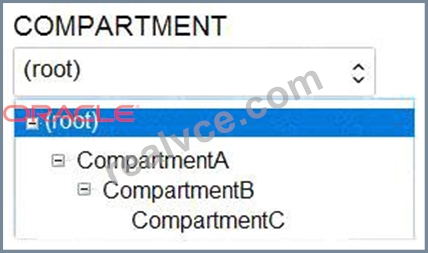
You want to create a policy in the root compartment to allow SystemAdmins to manage VCNs only in CompartmentC. Which policy is correct? (Choose the best answer.)
- A. Allow group SystemAdmins to manage virtual-network-family in compartment CompartmentC
- B. Allow group SystemAdmins to manage virtual-network-family in compartment Com-partmentA:
CompartmentB:CompartmentC - C. Allow group SystemAdmins to manage virtual-network-family in compartment CompartmentB:
CompartmentC - D. Allow group SystemAdmins to manage virtual-network-family in compartment Root
Answer: B
NEW QUESTION # 61
You have created the following JSON file to specify a lifecycle policy for one of your object storage buckets: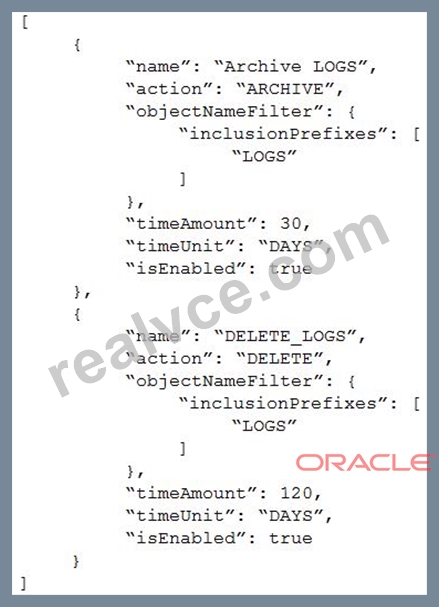
How will this policy affect the objects that are stored in the bucket? (Choose the best answer.)
- A. Objects containing the name prefix LOGS will be automatically migrated from standard Storage to Archive storage 30 days after the creation date. The object will be deleted 120 days after creation.
- B. Objects containing the name prefix LOGS will be automatically migrated from standard Storage to Archive storage 30 days after the creation date. The object will be mi-grated back to standard Storage 120 days after creation.
- C. The objects with prefix LOGS will be deleted 30 days after creation date.
- D. Objects with the prefix LOGS will be retained for 120 days and then deleted permanently.
Answer: A
NEW QUESTION # 62
SIMULATION
Scenario: 3 (Use the OCI CLI to Work with Object Storage from a Compute Instance) Scenario Description: (Hands-On Performance Exam Certification) Your company runs a web application in OCI that generates log files. You want to upload these files to OCI Object Storage to meet data retention requirements. Some files need to be retained indefinitely, whereas others can be deleted after 30 days. Use the OCI CLI to create bucket and upload the log directory and create a lifecycle policy rule to delete temporary files after 30 days.
Pre-Configuration:
To fulfill this requirement, you are provided with the following:
Access to an OCI tenancy, an assigned compartment, and OCI credentials
A compute instance with OCI CLI installed and a set of files in ~/dir_to_upload to use Access to the OCI Console Required IAM policies Assumptions:
Perform the tasks by using the OCI CLI on the compute instance.
Use instance principal authentication for all CLI commands; the instance has been given the policies necessary.
Connect to the compute instance using Cloud Shell's private networking and the provided SSH key.
An SSH key pair has been provided to you for the compute instance.
Private Key https://objectstorage.us-ashburn-1.oraclecloud.com/n/tenancyname/b/PBT_Storage/o/PKey.key Note: Throughout your exam, ensure to use assigned Compartment , User Name and Region.
Complete the following tasks in the provisioned OCI environment:
Task 1: Create a Bucket in Object Storage
Task 2: Upload a Directory's Contents to Object Storage
Task 3: Add a Lifecycle Policy to the Bucket
Answer:
Explanation:
See the solution below with Step by Step Explanation
Explanation:
Task 1: Create a Bucket in Object Storage
Create a bucket named CloudOpsBucket_<user id> with the following properties:
Storage tier: Standard
Auto-tiering: Disabled
Object versioning: Enabled
Emit events: Disabled
Keys: Oracle-managed
Visibility: Private
Task 2: Upload a Directory's Contents to Object Storage
Upload the contents of the directory ~/dir_to_upload and its subdirectories to the bucket CloudOpsBucket Task 3: Add a Lifecycle Policy to the Bucket Create a lifecycle policy rule that deletes all files from ~/dir_to_upload/temp after 30 days Task 1: Create a bucket in Object Storage
1. Open Cloud Shell in the console. Under Network along the top, select Ephemeral Private Network Setup.
2. Select the subnet of the compute instance.
3. SSH into the compute instance using the provided SSH key:
ssh -i /path/to/key opc@<private_ip>
4. In the compute instance, create the bucket with the following command (note that it's one long line):
oci os bucket create -c "<compartment_id>" --name "CloudOpsBucket" --auth instance_principal --versioning 'Enabled' Task 2: Upload a directory's contents to Object Storage
1. Upload the contents of the specified directory and subdirectories with the following command (note that it's one long line):
oci os object bulk-upload -bn "CloudOpsBucket" --src-dir "~/dir_to_upload" --auth instance_principal Task 3: Add a lifecycle policy to the bucket
1. Create a file named rule.json
2. Add the following content to rule.json:
{"items": [{"action": "DELETE","is-enabled": true,"name": "Delete-Rule","object-name-filter": {"exclusion-patterns": null,"inclusion-patterns": null,"inclusion-prefixes": ["temp/"]},"target": "objects","time-amount": 30,"time-unit": "DAYS"}]}
3. Add the lifecycle policy rule with the following command:
oci os object-lifecycle-policy put -bn "CloudOpsBucket" --from-json file://rule.json --auth instance_principal Top of Form
NEW QUESTION # 63
You created an Oracle Linux compute instance through the Oracle Cloud Infrastructure (OCI) management console then immediately realize you forgot to add an SSH key file. You notice that OCI compute service provides instance console connections that supports adding SSH keys for a running instance. Hence, you created the console connection for your Linux server and activated it using the connection string provided. However, now you get prompted for a username and password to login. What option should you recommend to add the SSH key to your running instance, while minimizing the administrative overhead? (Choose the best answer.)
- A. You need to modify the serial console connection string to include the identity file flag, to specify the SSH key to use.
- B. You need to terminate the running instance and recreate it by providing the SSH key file.
- C. You need to reboot the instance from the console, boot into the bash shell in maintenance mode, and add SSH keys for the OPC user.
- D. You need to configure the boot loader to use ttyS0 as a console terminal on the VM.
Answer: C
NEW QUESTION # 64
You have a web application that is running on compute instances distributed across an availability domain's fault domains. To share state, instances of the application need to read and write to a shared file system that supports concurrent access from multiple instances.
Which two can help fulfill this technical requirement?
- A. Create a file system in the File Storage service. Create a mount target and export the file system. Mount the export onto all of the instances.
- B. Attach a single block volume in read/write shared mode to alt the instances. Use a cluster aware system such as Oracle Cluster File System version 2 (OCFS2) to coordinate access to the shared volume.
- C. Attach a block volume to each instance. Enable replication between the block volumes.
- D. Attach a single block volume in read/write shared mode to all the instances. Enable the cluster plug-in on the Oracle Cloud Agent to coordinate access to the shared volume.
Answer: A,B
NEW QUESTION # 65
You have set an alarm to be generated when the CPU usage of a specified instance is greater than 10%. In the alarm behavior view below you notice that the critical condition happened around 23:30. You were expecting a notification after 1 minute, however, the alarm firing state did not begin until 23:33.
What should you change to fix it? (Choose the best answer.)
- A. Change the alarm trigger delay minutes value to 1.
- B. Change the alarm metric interval to 1.
- C. Change the notification topic that you previously associated with the alarm.
- D. Change the alarm condition to be grater than 3%.
Answer: A
NEW QUESTION # 66
You are an admin of an OCI tenancy. To save cost, you want to restrict the amount of OCPUs that can be provisioned in each compartment. Which will allow this?
- A. Resource Manager
- B. Budgets
- C. Compartment quotas
- D. Service limits
Answer: C
NEW QUESTION # 67
You have been asked to update the lifecycle policy for object storage using the Oracle Cloud Infrastructure (OCI) Command Line Interface (CLI). Which command can successful-ly update the policy? (Choose the best answer.)
- A. oci os object-lifecycle-policy put --ns <object_storage_namespace> --bn <bucket_name> -- --items
<json_formatted_lifecycle_policy> - B. oci os object-lifecycle-policy put --ns <object_storage_namespace> --bn <bucket_name>
- C. oci os object-lifecycle-policy delete --ns <object_storage_namespace> --bn <buck-et_name>
- D. oci os object-lifecycle-policy get --ns <object_storage_namespace> --bn <bucket_name>
Answer: A
NEW QUESTION # 68
You have recently been asked to take over management of your company infrastructure provisioning efforts, utilizing Terraform v0.12 to provision and manage infrastructure resources in Oracle Cloud Infrastructure (OCI).
For the past few days the development environments have been failing to provision. Terraform re-turns the following error:
You locate the related code block in the Terraform config and find the following:
Which correction should you make to solve this issue? (Choose the best answer.)
- A. Replace the curly braces { } in lines 11 and 16 with square braces [ ]
- B. Place a command at the end of line 16
- C. Modify line 15 to be the following: tcp_options { min = 22 max =22 }
- D. Modify line 15 to be the following: tcp_options = {min = 22, max =22)
Answer: C
NEW QUESTION # 69
Security Testing Policy describes when and how you may conduct certain types of security testing of Oracle Cloud Services, including vulnerability and penetration tests, as well as tests involving data scraping tools.
What does Oracle allow as part of this testing? (Choose the best answer.)
- A. Customers are allowed to use their own testing and monitoring tools.
- B. Customers can validate that their network resources are isolated from other customer resources.
- C. Customers are allowed to test Oracle Cloud Infrastructure (OCI) hardware related to resources in their tenancy.
- D. Customers can simulate DoS attack scenarios as long as it restricted to the customer own environment.
Answer: A
NEW QUESTION # 70
You have a group of developers who launch multiple VM.Standard3.Flex compute in-stances every day into the compartment Dev. As a result, your Oracle Cloud Infrastructure (OCI) tenancy quickly hits the service limit for this shape, and other groups can no longer create new instances using the VM.Standard3.Flex shape. Therefore, your company issues a new mandate that the Dev compartment must include a quota that allows the use of only 20 VM.Standard3.Flex OCPUs per availability domain, without affecting any other compartment in the tenancy. Which quota statement would you use to implement this new requirement?
- A. zero compute-core quotas in tenancy set compute-core quota standard3-core-count to 20 in compartment dev
- B. set compute-core quota standard3-core-count to 20 in compartment dev
- C. zero compute-core quotas in tenancy set compute-core quota standard3-core-count to 20 in tenancy dev
- D. set compute-core quota standard3-core-count to 20 in compartment dev where re-quest.region = us-phoenix-1
Answer: B
NEW QUESTION # 71
......
1z0-1067-24 Deluxe Study Guide with Online Test Engine: https://examcollection.realvce.com/1z0-1067-24-original-questions.html