


Latest Mar-2026 L5M5 Dumps PDF And Certification Training
Check your preparation for CIPS L5M5 On-Demand Exam
CIPS L5M5 Exam Syllabus Topics:
| Topic | Details |
|---|---|
| Topic 1 |
|
| Topic 2 |
|
| Topic 3 |
|
NEW QUESTION # 35
Which of the following scenarios best illustrate instances of bribery?
- A. Upon landing at Dhaka Airport, the customs official informs that a 'standard processing fee' of $20 is required to allow entry into the country upon which a receipt for payment will be given
- B. A buying organization excludes certain bidders from a high-value tender on the basis that these bidders have not detailed what environmental protection measures they would take
- C. During the audit of a luxury goods distributor, the auditor was asked to take a pen home as a gift. After checking organizational policy, the auditor accepted the gift
- D. A supplier has just sent the procurement official her invoice for approval. Included in her expenses is a large round sum figure for 'client entertainment' without any price breakdown
Answer: D
Explanation:
Choice B- 'Commercial organisations' commit an offence if they, or any person associated with them, bribes another person intending to obtain or retain business or a business advantage. The purpose of the expenditure is key, not necessarily the amount or what is being purchased. The extent to which the expenditure is incidental is also a factor. An itemised invoice providing a breakdown of the expense will be useful, along with further enquiries of the supplier. As there is no price breakdown, it is a valid reason to suspect the expense and is a form of bribe.
Incorrect answer:
Choice A- It is an offence to bribe another person or to be bribed. As per Bribery Act 2010, failing to prevent a bribe being paid to obtain or retain business or a business advantage is an offence. In this situation, the policy regarding acceptance of gifts was ahered to and is not bribery.
Choice C- Bribing a foreign official is an offence under the Bribery Act 2010. It is important to determine whether the fee is genuine or not; it should be accompanied with official notices and a receipt for payment. As the official informs it is a "standard processing fee" with documentary eveidence like a money receipt, it is not a case of bribery.
Choice D- As the requirement for the buying organisation was to detail environtmetal protection measures for a tender, the buying organisation has the right to reject bidders on this basis. This is not a form of bribery in any way.
Reference:
LO-1.1; Page 47-48; Issues impacting ethical and sustainable procurement and supply: modern slavery, bribery, corruption, fraud and human rights infringements
NEW QUESTION # 36
Which of the following could be considered a bribe? Select TWO
- A. A supplier bidding on a tender invites the buyer to play golf
- B. An agricultural organisation donates to a politician to vote in a certain way
- C. A buyer sends a gift basket to a supplier at Christmas
- D. A company pays an invoice two days early
Answer: A,B
Explanation:
Comprehensive and Detailed Explanation From Exact Extract of Documents:
Bribery involves offering something of value to influence decision-making improperly. According to the L5M5 study guide (p.47), inviting a buyer to play golf during a tender (A) and donating to a politician to influence voting (B) are clear examples of bribery. A Christmas gift (C) may sometimes be considered borderline depending on company policies, but it is generally not categorised as bribery unless intended to influence. Paying invoices early (D) is not bribery. Procurement professionals must comply with anti-bribery policies and legislation such as the UK Bribery Act to maintain integrity.
Reference: Managing Ethical Procurement and Supply (L5M5) Study Guide, p.47
NEW QUESTION # 37
Mahfuz, a Procurement Officer at GreenLine Industries, manages a contract with a supplier of key raw materials. He recently noticed the supplier's non-compliance with the company's CSR (Corporate Social Responsibility) policy. Despite addressing the issue in a meeting, no significant improvements have been made. What should Mahfuz do next?
- A. Terminate the contract
- B. Issue an ultimatum
- C. Escalate the issue to a senior manager
- D. Make a financial claim
Answer: C
Explanation:
Choice C - This is the correct answer. Escalating the issue allows for higher-level intervention, which may lead to more significant pressure on the supplier to comply with the CSR policy. Senior managers can also provide strategic direction on how to handle the situation.
Incorrect answer:
Choice A - This is a drastic step and should typically be a last resort. Terminating the contract without giving the supplier an adequate opportunity to improve or exhausting internal escalation processes may damage the business relationship and disrupt the supply chain.
Choice B - While this might push the supplier to act, it can come across as confrontational and may not lead to a constructive resolution. A more collaborative approach, such as involving senior management, is usually preferable.
Choice D- This option is not suitable unless the supplier's non-conformance has directly resulted in financial damages that can be substantiated. The scenario does not indicate such damages, so this is not an appropriate action at this stage.
Reference:
LO-2.4; Page 233-234; Escalating non-compliance and making exit arrangements
NEW QUESTION # 38
Which of the following is a requirement for an Environmental Management System (EMS) according to ISO 14001?
- A. Periodic reviews conducted by external auditors
- B. Setting recycling targets
- C. A sustainability policy statement
- D. An environmental policy statement
Answer: D
Explanation:
Choice B - Under ISO 14001: Environmental Management System (EMS), an organization is required to establish, implement, and maintain an environmental policy statement that reflects its commitment to environmental protection, regulatory compliance, and continuous improvement.
Incorrect answer:
Choice A - While sustainability is important, ISO 14001 specifically requires an environmental policy statement, not a sustainability policy. Sustainability encompasses a broader scope, including social and economic factors, whereas ISO 14001 focuses primarily on environmental aspects.
Choice C - ISO 14001 does not mandate specific recycling targets. Instead, it requires organizations to identify their environmental aspects and impacts, set environmental objectives, and develop action plans. Recycling may be one of the objectives, but it is not a mandatory requirement.
Choice D- While ISO 14001 requires periodic reviews (such as internal audits and management reviews), external audits are not mandatory unless the organization seeks ISO 14001 certification. Certification audits are conducted by third-party auditors, but internal audits and management reviews are the primary monitoring mechanisms required by the standard.
Reference:
LO-3.2; Page 284-285; Role of industry standards and frameworks used by organizations in securing ESG considerations and ethical standards
NEW QUESTION # 39
The Payra 1320MW Thermal Power Plant, one of the largest power producers in Bangladesh, recently halted production due to worker strikes over poor working conditions. This situation is a consequence of which of the following?
- A. Human rights
- B. Bribery
- C. Corruption
- D. Fraud
Answer: A
Explanation: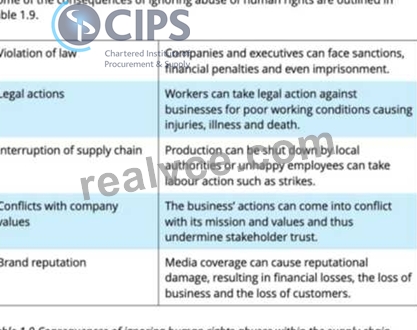
Choice A is the answer as we can see from above interruption of supply chain is a consequence of human rights abuse. The other factors are not directly related to production stoppage due to poor working conditions. Reference: LO-1.1; Page 52; Issues impacting ethical and sustainable procurement and supply: modern slavery, bribery, corruption, fraud and human rights infringements
NEW QUESTION # 40
Global sourcing often increases carbon emissions due to the long distances goods must travel. Which of the following strategies can help reduce this environmental impact?
- A. Increasing reliance on air freight for faster delivery
- B. Focusing exclusively on sourcing from local markets regardless of cost
- C. Sourcing from multiple distant suppliers to ensure competitive pricing
- D. Consolidating shipments to reduce the number of trips made
Answer: D
Explanation:
Choice B- Consolidating shipments means combining multiple orders into fewer deliveries, which reduces the total number of trips required. This approach leads to lower carbon emissions per unit of goods transported and enhances efficiency in logistics. Thus is the correct answer.
Incorrect answer:
Choice A- Using air freight can actually increase carbon emissions significantly compared to other transportation methods like shipping or rail. While it may expedite delivery, it is one of the most environmentally harmful ways to transport goods over long distances.
Choice C- While this strategy may help in achieving lower costs, it can increase carbon emissions due to the greater number of shipments required. Sourcing from many distant suppliers often leads to less efficient logistics and higher environmental impact.
Choice D- Although sourcing locally can significantly reduce transportation-related emissions, focusing solely on local markets may not always be practical or cost-effective. It can limit access to certain products, materials, or pricing advantages that global sourcing might provide. A balanced approach considering both environmental impact and cost is often necessary.
Reference:
LO-1.2; Page 79; ESG considerations in global sourcing
NEW QUESTION # 41
Vincent is a Procurement Manager in France. His company is considering joining the EU's EMAS system (Eco-Management and Audit Scheme). Which of the following are advantages of doing this? Select THREE
- A. It will benefit the company's reputation
- B. It will increase profits
- C. There is no cost to set up
- D. It focuses the organisation on improving environmental performance
- E. It allows the organisation to prove compliance with environmental legislation
Answer: A,D,E
Explanation:
Comprehensive and Detailed Explanation From Exact Extract of Documents:
The Eco-Management and Audit Scheme (EMAS) is a voluntary EU framework that supports organisations in improving environmental performance. The L5M5 study guide (p.279) explains that EMAS helps organisations by:
Focusing on continuous environmental performance improvement (A),
Allowing proof of compliance with environmental legislation (C),
Enhancing reputation and stakeholder trust (D).
However, it does not guarantee increased profits (B), and there are costs for audits and registration (E). EMAS can give organisations a competitive advantage by demonstrating environmental responsibility. For procurement, it helps in supplier evaluation, especially within the EU.
Reference: Managing Ethical Procurement and Supply (L5M5) Study Guide, p.279
NEW QUESTION # 42
Sustainability-related measures such as ESG are mandatory in all countries and compliance is governed by legislation. Is this TRUE?
- A. Yes - it is governed by the ILO
- B. No - it is not mandatory anywhere
- C. Yes - it is mandated by the UN
- D. No - it is only mandatory in some countries
Answer: D
Explanation:
Comprehensive and Detailed Explanation From Exact Extract of Documents:
The L5M5 study guide (p.181) explains that sustainability-related measures, such as ESG, are only mandatory in some countries, not universally. For instance, the UK has legislation banning single-use plastic straws, while other countries may not. International organisations like the UN and ILO promote sustainability, but they cannot impose legislation globally-any treaty or framework must be ratified into national law. This means compliance is fragmented and varies across jurisdictions. Procurement professionals must therefore remain vigilant, as sourcing internationally exposes them to differing sustainability obligations and standards.
Reference: Managing Ethical Procurement and Supply (L5M5) Study Guide, p.181
NEW QUESTION # 43
Which scenario best illustrates the inclusion of a community benefits clause in a procurement contract?
- A. A contractor commits to employing a percentage of workers from the local community and offering training programs for skill development
- B. A procurement contract mandates penalties for late delivery of goods
- C. A construction company agrees to use locally sourced materials to reduce costs
- D. A supplier is required to adhere to strict environmental standards during project execution
Answer: A
Explanation:
Choice B- A community benefits clause is included in procurement contracts to promote social and economic benefits for local communities. This often includes actions like creating job opportunities, providing training, or supporting local businesses, as described in option B.
Incorrect answer:
Choice A- Focuses on cost reduction rather than community benefits.
Choice C- Relates more to environmental considerations than community development.
Choice D- This option is about enforcement mechanisms, not generating community benefits.
Reference:
LO-2.2; Page 186-187; Monitoring Contract Performance
NEW QUESTION # 44
XYZ Corporation has been acquired by a global company that plans to centralize all sourcing activities and standardize processes. Which factor could help XYZ Corporation gain a competitive advantage through this centralization?
- A. Improved benchmarking shared data to provide ability to agree prices with global competitors
- B. Increased due diligence activity resulting in lower governance of suppliers
- C. Ability to use more favorable legislation in different countries and avoid local legal obligations
- D. Efficiency gains that lead to increased productivity and lower prices
Answer: A
Explanation:
Choice B- Improved benchmarking and shared data can help a company agree on prices with global competitors and gain a competitive advantage. Option B is the correct answer.
Incorrect answer:
Choice A- Legal obligations have to be maintained from wherever the company is operating. Avoiding or adhering to legislations is not a competitive advantage.
Choice C- Competitive advantage can best be described as what sets an organization apart. Increased efficiency is the result of competitive advantage but not a competitive advantage itself.
Choice D- Increased due diligence activity resulting in lower governance of suppliers is not a competitive advantage for XYZ Corporation.
Reference:
LO-1.2; Page 63-65; Competitive advantage through global sourcing
NEW QUESTION # 45
A supplier has contracted to deliver a customized piece of machinery to a manufacturing company under a "payment following performance" clause. After delivery, the buyer delays payment, citing the need for additional testing to verify compliance with the agreed specifications.
What is the greatest risk the supplier faces under this "payment following performance" system in this scenario?
- A. The supplier might fail to deliver on time and face penalties
- B. The supplier might receive full payment before addressing the buyer's concerns
- C. The buyer might demand additional goods or services at no extra cost
- D. The buyer might reject the machinery without valid reasons
Answer: D
Explanation:
Choice A- Under a "payment following performance" system, the supplier bears the risk of non-payment or delays if the buyer disputes the performance, even without valid reasons.
Incorrect answer:
Choice B- Payment before addressing concerns contradicts the "payment following performance" system.
Choice C- Demanding additional goods or services is not directly tied to the payment terms.
Choice D- Delivery timing issues relate to performance obligations, not payment risk.
Reference:
LO-2.2; Page 189; Monitoring Contract Performance
NEW QUESTION # 46
Santino is a procurement manager at ABC Ltd. He manages a contract with a supplier. The relationship is characterised by both companies seeking advantages at the expense of the other. What type of relationship does Santino have with his supplier?
- A. Partnership
- B. Transactional
- C. Closer tactical
- D. Adversarial
Answer: D
Explanation:
Comprehensive and Detailed Explanation From Exact Extract of Documents:
The correct answer is Adversarial. The relationship spectrum described in the L5M5 study guide (p.151) outlines different approaches to supplier relationships: transactional, adversarial, tactical, and partnership. An adversarial relationship exists where both parties compete rather than collaborate, often trying to maximise their own benefit at the expense of the other. This type of relationship is common in short-term, price-driven procurement arrangements but is not conducive to long-term collaboration or ethical supply chain practices. Partnership relationships (A) involve cooperation and shared goals, transactional (B) are short-term and arms-length but neutral, and closer tactical (C) involve selective collaboration. Procurement professionals are encouraged to move away from adversarial relationships to more cooperative models where possible.
Reference: Managing Ethical Procurement and Supply (L5M5) Study Guide, p.151
NEW QUESTION # 47
Which of the following ISO standards relates to Environmental Management Systems?
- A. ISO31000
- B. ISO9001
- C. ISO28000
- D. ISO14001
Answer: D
Explanation:
Comprehensive and Detailed Explanation From Exact Extract of Documents:
ISO14001 is the international standard for Environmental Management Systems (EMS). The L5M5 study guide (p.277) explains that it requires organisations to establish frameworks for monitoring and improving their environmental impact. ISO9001 (A) relates to quality management, ISO28000 (C) to supply chain security, and ISO31000 (D) to risk management. For procurement, suppliers certified with ISO14001 demonstrate a commitment to reducing waste, emissions, and environmental risks, making this highly relevant to CSR and ESG.
Reference: Managing Ethical Procurement and Supply (L5M5) Study Guide, p.277
NEW QUESTION # 48
Abed, the CEO of a manufacturing firm, plans to introduce an ESG policy. During a board meeting, concerns were raised about potential employee resistance to the initiative. What could be the most likely cause of this resistance?
- A. ESG policies require change which the employees are afraid of
- B. ESG policies require extra resources in both time and money
- C. Negative publicity
- D. A good ESG strategy promotes innovation
Answer: A
Explanation:
Choice D- ESG policies require change and many employees are worried by change. Thus D is the correct answer!
Incorrect answer:
Choice A- ESG agendas increases business reputation and does not negatively publicize.
Choice B- Requiring extra resources is a matter of the management and does not concern the employees.
Choice C- Promoting innovation is a positive effect of ESG policies and leads to more engaged employees.
Reference:
LO-1.1; Page 7; Analyze the application of ethical and ESG (Environmental, Social and Governance) factors in supple chains
NEW QUESTION # 49
A company dedicated to sustainable procurement is evaluating its processes to integrate Fair Trade goods. At which stage of the procurement process can Fair Trade requirements be most strategically incorporated?
- A. During pre-procurement planning and market research
- B. During tender specification development and supplier evaluation
- C. When monitoring supplier compliance during the contract term
- D. After contract award, during supplier performance evaluation
Answer: B
Explanation:
Choice D- This is the most strategic stage for including Fair Trade requirements, as it ensures suppliers are aware of the criteria upfront and allows for evaluation based on their adherence to these standards.
Incorrect answer:
Choice A - While monitoring suppliers post-contract is important, it's reactive rather than strategic. The ability to enforce Fair Trade requirements is limited if they weren't specified from the start.
Choice B - This stage helps identify Fair Trade suppliers and assess feasibility but doesn't directly bind suppliers to comply with Fair Trade standards.
Choice C - Compliance monitoring is crucial for maintaining standards, but it's not the stage where requirements are introduced.
Reference:
LO-3.3; Page 311-312; Fairtrade standards that affect the workplace and producers and their implications for procurement and supply
NEW QUESTION # 50
......
Valid L5M5 Dumps for Helping Passing CIPS Exam: https://examcollection.realvce.com/L5M5-original-questions.html