


Get 2025 Most Reliable PMI PMI-ACP Training Materials
The Realest Study Materials PMI-ACP Dumps
NEW QUESTION # 30 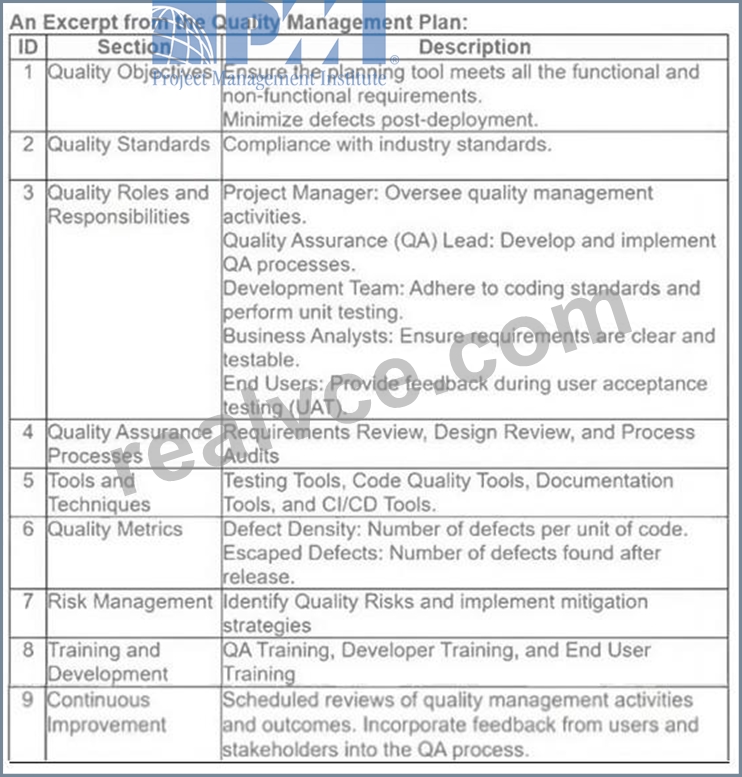
In a project to develop a supply-and-demand scenario planning tool, the team aims to streamline development and rapidly deliver features. Which approach best supports quick feature delivery while maintaining quality?
(Refer to An Excerpt from the Quality Management Plan)
- A. Organizing training sessions for end users to ensure effective utilization of the planning tool
- B. Implementing a systematic approach to automate integration, testing, and deployment activities
- C. Leveraging regular reviews, feedback loops, and lessons learned to adjust at key milestones
- D. Increasing the frequency of stakeholder meetings to gather feedback on feature priorities
Answer: B
Explanation:
To support quick feature delivery while maintaining quality, the best approach is to automate integration, testing, and deployment activities. This aligns with the principles of Continuous Integration and Continuous Deployment (CI/CD), which streamline processes and reduce the manual effort required to test and deploy software. This approach can help the team to quickly release features with confidence that they meet quality standards, reducing manual errors and speeding up the delivery cycle.
NEW QUESTION # 31
Why should an agile coach model agile principles and behaviors, become self-aware, and be present?
- A. To better listen, serve, and help the team grow their strengths individually and as a team
- B. To help better disguise the command and control approach
- C. To convince people what they need to do
- D. To understand team dynamics and develop a high performing team
Answer: A
Explanation:
The correct answer is A - To better listen, serve, and help the team grow their strengths individually and as a team.
An agile coach is a servant-leader whose role is to guide the team by modeling agile values, being present, actively listening, and helping teams grow. Coaching in agile is about enabling-not controlling-the team. A coach's mindfulness, authenticity, and presence inspire the same behaviors in the team.
PMI Agile Practice Guide notes:
"The agile coach models the agile mindset, including being present, self-aware, and aligned with agile principles. This helps the team build trust, foster collaboration, and grow capabilities organically." (PMI Agile Practice Guide, Section 6.2 - Coaching the Agile Team) Mike Griffiths emphasizes:
"Effective coaches guide by example. By modeling agile values and demonstrating presence, emotional intelligence, and listening, coaches help teams unlock their full potential." (PMI-ACP Exam Prep, Chapter 4 - Team Performance) Incorrect options:
* B suggests control rather than collaboration.
* C is anti-agile and contrary to the servant-leader model.
* D is valid but lacks the depth of A, which captures the coach's mindset and actions.
NEW QUESTION # 32 
Based on me burndown chart, what is the iteration's status?
- A. It trended ahead of schedule and completed everything on time
- B. It took less time than expected and had to be shortened
- C. It trended behind schedule and did not complete everything on time
- D. It took more time than expected and had to be lengthened
Answer: C
NEW QUESTION # 33
A product owner for two highly visible projects spends a great deal of time meeting with and reporting to senior stakeholders. The product owner is overwhelmed because both project teams request clarification on the requirements and the overall priorities. What should the agile project manager do?
- A. Provide both project teams with the highest priority needs.
- B. Provide both teams with each project's documentation.
- C. Facilitate a meeting with each team and the product owner to find a solution.
- D. Request the project teams' questions in writing prior to the next meeting.
Answer: C
NEW QUESTION # 34
During the iteration planning of a newly onboarded agile team, the product owner adds a set of high priority user stories into the iteration backlog. What should the team do first to define the tasks needed to implement the user stories?
- A. Meet with the customer
- B. Assign tasks to each team member
- C. Identify the Scrum Master
- D. Self-organize
Answer: D
Explanation:
The correct answer is A - Self-organize. One of the fundamental principles of agile is that teams are self- organizing and cross-functional. During iteration planning, once the stories are accepted into the sprint, the team collaborates to break down those stories into tasks and assign work among themselves based on skills and interest.
From the PMI Agile Practice Guide:
"Agile teams are self-organizing, meaning they collectively decide how to accomplish their work, rather than being directed by others. This principle supports autonomy and trust, and enhances team ownership and commitment." (PMI Agile Practice Guide, Section 4.3 - Team Performance) Mike Griffiths reinforces:
"Agile teams are trusted to manage themselves. Once user stories are selected during iteration planning, the team decomposes stories into tasks and self-assigns work collaboratively." (Mike Griffiths, PMI-ACP Exam Prep, Chapter 4 - Team Performance) Incorrect options:
* B contradicts agile principles of self-assignment and voluntary collaboration.
* C may be valuable for clarification but is not the first action after stories are added.
* D identifying the Scrum Master is irrelevant to the task breakdown phase.
NEW QUESTION # 35
On a team new to Scrum, two team members are disrupting the daily standup with a side conversation.
The ScrumMaster should:
- A. immediately intervene to remedy the disruptive situation.
- B. wait for the empowered, self-organizing team to resolve the issue.
- C. wait until the standup is over and then talk to the disruptive team members.
- D. record the issue and then raise the issue at the Sprint Retrospective.
Answer: A
NEW QUESTION # 36
The Sprint retrospective:
- A. Is held at the end of each release
- B. Is conducted to provide the sponsor with key information on team progress
- C. Is optional
- D. Is intended to promote continuous process improvements
Answer: D
Explanation:
Explanation/Reference:
NEW QUESTION # 37
An agile project manager is planning the initial scope, schedule and cost range estimates on a new project.
The team will be using Kanban to control work.
What metrics should the team use to measure performance?
- A. Lead time, throughput and due date performance
- B. Work in progress limits Kanban board, and time boxes
- C. Work item types, sprint cadences, and defect classes
- D. Burndown charts, scatter diagrams, and throughput
Answer: A
NEW QUESTION # 38 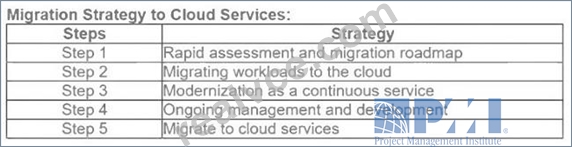
A project manager is working on a database migration project to cloud services (Refer to Migration Strategy to Cloud Services table). The project team has accumulated significant technical debt over several sprints due to pressure to deliver features quickly. This debt is now impacting their ability to deliver new features, leading to a notable decline in product performance and customer satisfaction.
Identify the actions the team should take to effectively manage technical debt while consistently delivering high-value features that align with stakeholder expectations.
- A. Ignore the technical debt foe now and focus exclusively on delivering new features so that the project can maintain a competitive advantage and stakeholder satisfaction.
- B. Form a separate learn dedicated lo handling technical debt, allowing the current team to focus on new features to maintain a competitive advantage and stakeholder satisfaction.
- C. Dedicate multiple consecutive sprints solely to addressing technical debt, halting new feature development temporarily to minimize the impact on the project's overall goals.
- D. Include technical debt tasks in every sprint, treating them with the same level of priority as new features, and continuously review the impact on the project's overall goals.
Answer: D
Explanation:
Managing technical debt is crucial for the long-term health of the project. The most effective approach is to include technical debt tasks in every sprint, ensuring that the debt is addressed incrementally without disrupting the flow of new feature development. By treating technical debt as a priority alongside new features, the team can reduce the impact of technical debt over time, maintain product quality, and align with stakeholder expectations. Continuous review of the impact ensures that the team is making informed decisions and balancing both short-term delivery and long-term maintainability. This approach also allows the team to meet performance expectations and customer satisfaction more consistently.
NEW QUESTION # 39
For a critical project, a new team has been formed from various departments. The project manager should start team building by:
- A. Assembling the team and asking the members to achieve a milestone in a small iteration.
- B. Assembling the team and discussing roles and responsibilities of each member on the team.
- C. Creating a project charter, documenting roles and responsibilities of each member, and sending it to the team members.
- D. Taking the team offsite for icebreaker sessions and other activities to ensure team members get to know each other.
Answer: B
Explanation:
Explanation/Reference:
NEW QUESTION # 40
An agile team discovers a new risk and identifies that its impact may be severe. What should an agile practitioner recommend?
- A. Balance risk reduction and value adding activities in the next iteration.
- B. Add a goal to the current iteration to fully mitigate or control the risk.
- C. Continue with the current plan to maintain team velocity.
- D. Update the risk register and seek direction from a risk specialist.
Answer: B
NEW QUESTION # 41
Which option describes how risk should be managed in an agile project?
- A. All stakeholders are responsible for identifying risks during standups, retrospectives, and other team meetings.
- B. Project team members would each be responsible for identifying and managing risks for the individual user stones they have been assigned
- C. Since using an agile methodology minimizes risk in project management, the project team can focus on delivering business value over managing risk.
- D. The product owner is responsible for identifying risks and entering them into the backlog so that their mitigation can be prioritized.
Answer: A
NEW QUESTION # 42
What key benefits might stakeholders realize from an Agile approach?
- A. The early and continuous delivery of valuable software, providing increased visibility and the opportunity for more frequent adjustments
- B. The ability to bypass the change-management process, inserting new requirements and changes directly into the team as they meet daily
- C. The team's flexibility to make changes mid-iteration as business needs or priorities change, increasing the ability of the team to meet project commitments
- D. Increased access to the project and less reliance on formal reports and status meetings to better understand the current work and the risks the team is accepting
Answer: A
NEW QUESTION # 43
Early in a project, stakeholder analysis is performed; however, an organizational restructure redefines key roles.
What should the project team do?
- A. Obtain a copy of the redefined key roles to update the stakeholder analysis
- B. Email a copy of the project vision to those redefined for key roles and ask if they need to be involved in the project
- C. Use direct engagement and two-way conversation to update the stakeholder analysis for any new stakeholder requirements
- D. Note the changes to the restructure and roles that affect team activities
Answer: A
NEW QUESTION # 44
During sprint retrospectives, some team members are very vocal and tend to dominate the conversation, while others are more reserved and less likely to participate. What should the scrum master do?
- A. Use retrospective techniques, such as silent writing, clustering, and dot voting to field feedback prior to discussion by the team.
- B. Ask more specific questions during the retrospectives.
- C. Encourage all team members to participate, and have them type their retrospective feedback into the agile lifecycle management tool.
- D. Ask team members to email feedback that can be summarized in a spreadsheet for the team.
Answer: C
NEW QUESTION # 45
What should the agile coach do?
- A. Move this database administrator to another team so that team members learn database-related tasks.
- B. Add another database administrator to balance the workload and aid with knowledge retention.
- C. Start the hiring process for a new, equally skilled database administrator as a replacement.
- D. Obtain agreement from the team that, on upcoming sprints, the database administrator will act only in an advisory capacity.
Answer: B
Explanation:
The presence of asingle point of knowledgeis a significant risk in agile teams. According to thePMI Agile Practice Guide (Section 4.3.3: Team Structure and Cross-functionality)andMike Griffiths' PMI-ACP Exam Prep Book (Chapter 3: Team Performance), agile teams shouldavoid role silosand promote knowledge sharing. Adding another database administrator helps with bothworkload distributionand knowledge retentionthrough pairing or mentoring.
* Option Cis correct: it ensuresredundancy and knowledge spread, reducing project risk.
* Option Adoes not address knowledge transfer or team development.
* Option Bremoves the knowledge resource, worsening the risk.
* Option Dlimits knowledge-sharing and still creates a bottleneck.
NEW QUESTION # 46
To create the project vision, an agile team has scheduled an initial meeting with their customer representative.
What should the team bring to this meeting?
- A. A list of project stakeholders and user stories
- B. A list of questions for the team and customer representative
- C. A list of templates to be used to create the project vision
- D. A checklist for future acceptance tests for project deliverables
Answer: B
Explanation:
The correct answer is D - A list of questions for the team and customer representative.
In Agile, creating a shared product vision is a collaborative effort that begins with open dialogue. The team should prepare insightful, value-driven questions to understand the customer's needs, pain points, desired outcomes, and business drivers. This supports co-creation of the vision rather than relying on rigid documentation.
PMI Agile Practice Guide:
"A shared product vision aligns the team and stakeholders. Early collaboration and asking the right questions help establish understanding and purpose." (PMI Agile Practice Guide, Section 2.2 - Agile Mindset) Mike Griffiths:
"Visioning meetings are facilitated conversations where teams and stakeholders explore product goals and user needs. Questions-not documents-drive clarity." (PMI-ACP Exam Prep, Chapter 1 - Agile Principles and Mindset) Incorrect options:
* A implies a rigid, document-driven mindset-contrary to Agile.
* B assumes the backlog exists before visioning.
* C is too early for acceptance criteria before vision alignment.
NEW QUESTION # 47
Which of the following is NOT a prioritization technique?
- A. Minimally Marketable Features (MMF)
- B. Planning Poker
- C. User Story Mapping
- D. Kano analysis
- E. Kitchen Prioritization
Answer: B
NEW QUESTION # 48
When facilitated and managed well, the primary benefits of a project retrospective should be to:
- A. Provide an open forum for team member complaints.
- B. Allow the team to get ahead on release planning.
- C. Identify the most important issues for the sponsors.
- D. Increase empowerment and enjoyment for the team.
Answer: B
Explanation:
Explanation/Reference:
Explanation:
NEW QUESTION # 49
A software team is developing a product in an environment with increased uncertainty. Although there is a clear vision of the goals to be achieved, the product owner is not fully certain about how some of the product features should work.
How should the product owner address this situation?
- A. Consider moving to a more predictive product development approach.
- B. Develop a prototype of the product to obtain feedback from users.
- C. Facilitate more product planning sessions with the software team.
- D. Improve the product testing and quality assurance skills among the team
Answer: B
Explanation:
When there is uncertainty about how certain product features should work, creating a prototype is an effective way to reduce that uncertainty. Prototyping allows the product owner to test ideas, gather feedback from users early in the process, and make adjustments based on real-world input. This approach helps clarify the product's functionality and ensure that the team is building something that meets user needs, all while maintaining flexibility and adaptability in the Agile environment.
NEW QUESTION # 50
Which of the following are TRUE about the Sprint Review? (Choose two).
- A. It should be a formal presentation
- B. Stakeholders may attend
- C. The Product Owner presents what backlog items are "Done"
- D. The Scrum Master demonstrates the product
Answer: B,C
NEW QUESTION # 51
Which type of story would be used when an estimate is not available due to lack of knowledge of the technology required to implement the story?
- A. Nonfunctional
- B. Spike
- C. Defect
- D. Slack
Answer: B
Explanation:
Explanation/Reference:
NEW QUESTION # 52
What is the normal time estimate for a research story?
- A. 1 hour
- B. 1 iteration
- C. 1 day
- D. Half an hour
Answer: C
NEW QUESTION # 53
......
Preparing for the PMI-ACP certification exam requires a significant amount of study and preparation. Individuals must have a strong understanding of agile principles, practices, and techniques. They must also be familiar with the various tools and techniques used in agile projects. Many individuals choose to take a PMI-ACP exam preparation course to help them prepare for the exam.
For more info visit:
LATEST PMI-ACP Exam Practice Material: https://examcollection.realvce.com/PMI-ACP-original-questions.html