


About our products
Our website offers latest study material that contains valid Associate-Developer-Apache-Spark-3.5 real questions and detailed Associate-Developer-Apache-Spark-3.5 exam answers, which written and tested by IT experts and certified trainers. The Associate-Developer-Apache-Spark-3.5 exam dumps have exactly 90% similarity to questions in the Associate-Developer-Apache-Spark-3.5 real test. One week preparation prior to attend exam is highly recommended. Free demo of our Associate-Developer-Apache-Spark-3.5 exam collection can be downloaded from exam page.

If you failed, what should you do?
If you got a bad result in exam, first you can choose to wait the updating of Associate-Developer-Apache-Spark-3.5 exam dumps or free change to other dumps if you have other test. If you want to full refund, please within 7 days after exam transcripts come out, and then scanning the transcripts, add it to the emails as attachments and sent to us. After confirmation, we will refund immediately.
Our website is an influential leader in providing valid online study materials for IT certification exams, especially Databricks certification. Our Databricks Certified Associate Developer for Apache Spark 3.5 - Python exam collection enjoys a high reputation by highly relevant content, updated information and, most importantly, Associate-Developer-Apache-Spark-3.5 real questions accompanied with accurate Associate-Developer-Apache-Spark-3.5 exam answers. The study materials of our website contain everything you need to get high score on Associate-Developer-Apache-Spark-3.5 real test. Our aim is always to provide best quality practice exam products with best customer service. This is why more and more customers worldwide choose our website for their Databricks Certified Associate Developer for Apache Spark 3.5 - Python exam dumps preparation.
What is online test engine?
Online test engine provides users with Associate-Developer-Apache-Spark-3.5 exam simulations experience. It enables interactive learning that makes exam preparation process easier and can support Windows/Mac/Android/iOS operating systems, which means you can practice your Associate-Developer-Apache-Spark-3.5 real questions and test yourself by Associate-Developer-Apache-Spark-3.5 practice exam. There is no limit of location or time to do Associate-Developer-Apache-Spark-3.5 exam simulations. Online test engine perfectly suit to IT workers
How long will you received your dumps after payment
After you make payment, if the payment was successful and you will receive our email immediately, you just need to click the link in the email and download your Associate-Developer-Apache-Spark-3.5 real questions immediately.
Databricks Associate-Developer-Apache-Spark-3.5 Exam Syllabus Topics:
| Section | Weight | Objectives |
|---|---|---|
| Topic 1: Developing Apache Spark DataFrame API Applications | 30% | - Creating DataFrames and defining schemas - Selecting, renaming, and modifying columns - User-defined functions (UDFs) - Partitioning and bucketing data - Handling missing values and data quality - Filtering, sorting, and aggregating data - Joining and combining datasets - Reading and writing data in various formats |
| Topic 2: Structured Streaming | 10% | - Fault tolerance and state management - Defining streaming queries - Streaming concepts and architecture - Output modes and triggers |
| Topic 3: Using Pandas API on Apache Spark | 5% | - Converting between Pandas and Spark structures - Overview of Pandas API on Spark - Key differences and limitations |
| Topic 4: Using Spark Connect to Deploy Applications | 5% | - Spark Connect architecture - Running applications via Spark Connect - Connecting to remote Spark clusters |
| Topic 5: Apache Spark Architecture and Components | 20% | - Shuffling, actions, and broadcasting - Execution and deployment modes - Fault tolerance and garbage collection - Execution hierarchy and lazy evaluation - Spark architecture overview |
| Topic 6: Troubleshooting and Tuning Apache Spark DataFrame API Applications | 10% | - Debugging and logging - Optimizing transformations and actions - Identifying performance bottlenecks - Managing memory and resource usage |
| Topic 7: Using Spark SQL | 20% | - Working with functions and expressions - Using catalog and metadata APIs - Running SQL queries - Integrating Spark SQL with DataFrames |
Databricks Certified Associate Developer for Apache Spark 3.5 - Python Sample Questions:
22 of 55.
A Spark application needs to read multiple Parquet files from a directory where the files have differing but compatible schemas.
The data engineer wants to create a DataFrame that includes all columns from all files.
Which code should the data engineer use to read the Parquet files and include all columns using Apache Spark?
- A. spark.read.parquet("/data/parquet/")
- B. spark.read.format("parquet").option("inferSchema", "true").load("/data/parquet/")
- C. spark.read.parquet("/data/parquet/").option("mergeAllCols", True)
- D. spark.read.option("mergeSchema", True).parquet("/data/parquet/")
Correct Answer: D 🗳️
Explanation: Only visible for RealVCE members. You can sign-up / login (it's free).
18 of 55.
An engineer has two DataFrames - df1 (small) and df2 (large). To optimize the join, the engineer uses a broadcast join:
from pyspark.sql.functions import broadcast
df_result = df2.join(broadcast(df1), on="id", how="inner")
What is the purpose of using broadcast() in this scenario?
- A. It filters the id values before performing the join.
- B. It ensures that the join happens only when the id values are identical.
- C. It reduces the number of shuffle operations by replicating the smaller DataFrame to all nodes.
- D. It increases the partition size for df1 and df2.
Correct Answer: C 🗳️
Explanation: Only visible for RealVCE members. You can sign-up / login (it's free).
11 of 55.
Which Spark configuration controls the number of tasks that can run in parallel on an executor?
- A. spark.executor.cores
- B. spark.task.maxFailures
- C. spark.executor.memory
- D. spark.sql.shuffle.partitions
Correct Answer: A 🗳️
Explanation: Only visible for RealVCE members. You can sign-up / login (it's free).
Given the following code snippet in my_spark_app.py: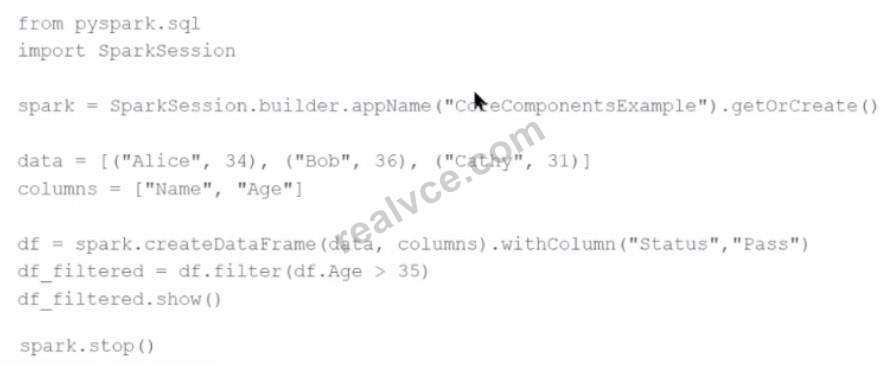
What is the role of the driver node?
- A. The driver node stores the final result after computations are completed by worker nodes
- B. The driver node holds the DataFrame data and performs all computations locally
- C. The driver node only provides the user interface for monitoring the application
- D. The driver node orchestrates the execution by transforming actions into tasks and distributing them to worker nodes
Correct Answer: D 🗳️
Explanation: Only visible for RealVCE members. You can sign-up / login (it's free).
7 of 55.
A developer has been asked to debug an issue with a Spark application. The developer identified that the data being loaded from a CSV file is being read incorrectly into a DataFrame.
The CSV file has been read using the following Spark SQL statement:
CREATE TABLE locations
USING csv
OPTIONS (path '/data/locations.csv')
The first lines of the command SELECT * FROM locations look like this:
| city | lat | long |
| ALTI Sydney | -33... | ... |
Which parameter can the developer add to the OPTIONS clause in the CREATE TABLE statement to read the CSV data correctly again?
- A. 'header' 'true'
- B. 'sep' '|'
- C. 'sep' ','
- D. 'header' 'false'
Correct Answer: A 🗳️
Explanation: Only visible for RealVCE members. You can sign-up / login (it's free).


 Basil
Basil 
 Bertram
  Juliet
 Nicholas
  Louis
Louis  Jane
Jane  Michael
  Frederic
  Byron
Byron 
 Hilda
Hilda  Hayden
  Ella
Ella  Andrea
  Liz
Liz  Rudolf
  Monroe
  Justin
  Georgia
  Xavier


